TPRM 2.0: Why the "Annual Assessment" Is Dead and "Continuous Telemetry" Is the New Standard
For years, Third-Party Risk Management (TPRM) followed a predictable, compliance-driven ritual. Once a year, your risk team would trigger a massive, multi-page spreadsheet questionnaire, email it to your critical vendors, and wait weeks for a response. Your team would then review the answers, check a box, and file it away until the next annual review cycle.
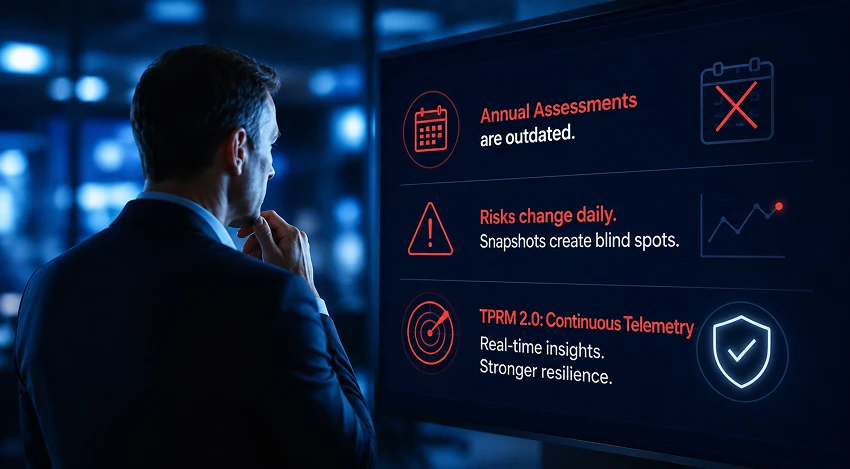
But let’s be entirely real: that model is an operational illusion. An annual point-in-time risk assessment is nothing more than a static snapshot of a vendor's security and financial posture on a single day. In our hyper-connected ecosystem, a vendor can pass an assessment with flying colors on a Tuesday, experience a catastrophic cloud misconfiguration or a critical leadership shakeup on a Thursday, and leave your organization exposed for the next 364 days. As we hit the midway point of 2026, the traditional annual assessment is officially dead. Driven by the stringent demands of global regulations like DORA and the technical breakthroughs of ServiceNow’s Xanadu and Zurich releases, enterprise risk has shifted into the era of TPRM 2.0: Continuous Telemetry.The Structural Breakdown: Static vs. Continuous Risk
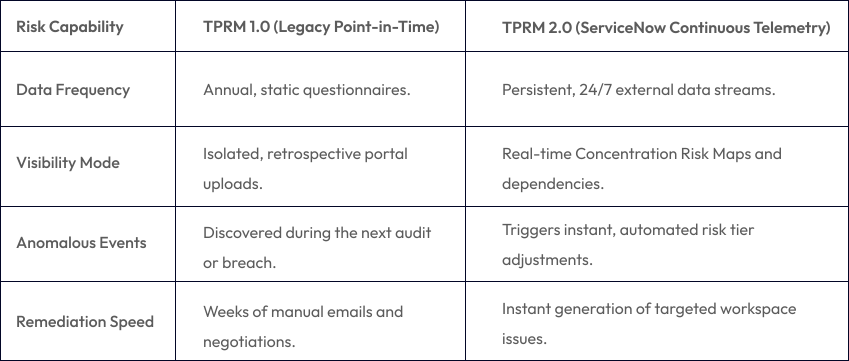
Relying on legacy point-in-time assessments means operating with a dangerous blind spot. Enterprise risk fluctuates by the second. The table below highlights how the paradigm has shifted from backwards-looking administration to forward-looking execution:
Inside the Tech: The 2026 ServiceNow Architecture Driving TPRM 2.0
With ServiceNow rebranding and supercharging its risk ecosystem into Third-Party Risk Management (TPRM), the platform has evolved from a passive tracking workspace into a dynamic intelligence hub. The platform relies on three core updates to enforce continuous telemetry:
Inbound Risk Intelligence Engines
ServiceNow no longer forces you to wait for a vendor's self-reported survey. TPRM natively ingests external, continuously updated risk intelligence feeds (spanning cybersecurity ratings, financial health trackers, and geo-political volatility streams). If a tier-1 partner's infrastructure exhibits a sudden drop in its external security posture rating, the platform registers the telemetry lapse immediately.
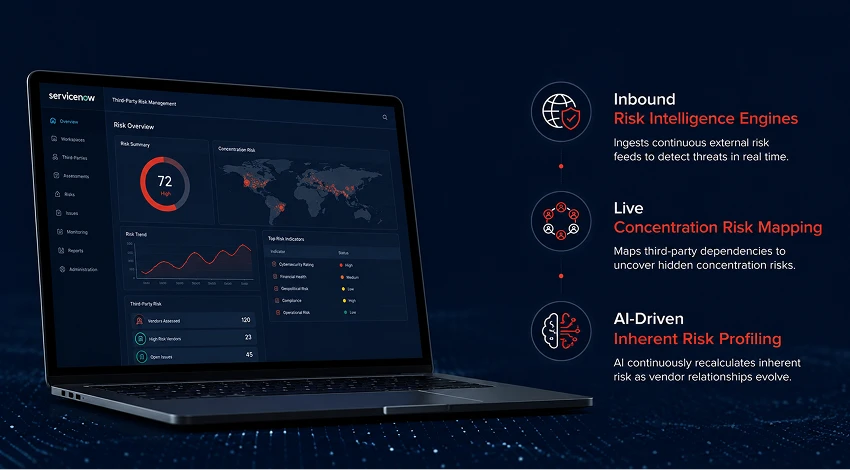
Live Concentration Risk Mapping
A major feature consolidated in the recent Zurich release cycle is the Concentration Risk Map. Instead of reviewing vendors in isolation, ServiceNow correlates your third-party footprint against your live enterprise infrastructure and services. The platform visualizes aggregate vulnerabilities, revealing hidden single-point-of-failure risks such as discovering that five seemingly unrelated software applications all rely on the exact same compromised downstream hosting vendor.
AI-Driven Inherent Risk Profiling
Driven by Now Assist for Integrated Risk Management (IRM), the platform utilizes advanced AI to continuously audit a vendor's operational data. When a vendor relationship changes such as a partner gaining access to a higher tier of proprietary customer PII Now Assist automatically recalculates their inherent risk profile, prompting an instantaneous shift in compliance guardrails without requiring manual human oversight.
From Signal to Mitigation: The Autonomous Workflow in Action
What happens when continuous telemetry catches an active threat? In the old world, the signal sat in a siloed security tool until a human analyst found it. In 2026, ServiceNow transforms data directly into automated defense plans:
The Trigger: An external rating provider flags a critical data-leak vulnerability on an active supplier’s public-facing application server.The Orchestration: ServiceNow’s automated TPRM engine matches the supplier against your internal services, realizing this specific vendor handles your primary logistics portal.The Action: The platform automatically logs an active Issue, generates a targeted, context-aware remediation micro-questionnaire, routes it via the Third-Party Portal straight to the vendor’s security team, and temporarily lowers their operational trust score in the system all within minutes of the initial telemetry flag.The Strategic Bottom Line
In 2026, third-party risk is synonymous with enterprise operational risk. You cannot protect an agile, modern enterprise using slow, historic data-gathering methods.
By upgrading your risk architecture to ServiceNow Third-Party Risk Management, you stop managing risk through a rearview mirror. You grant your risk officers, procurement specialists, and security teams the continuous visibility required to spot external threats early, isolate vulnerabilities instantly, and defend your enterprise ecosystem long before an external failure impacts your operations.