
ServiceNow Scales the Autonomous Workforce Across the Enterprise
The era of advisory artificial intelligence is rapidly giving way to a new paradigm of governed, autonomous execution. For years, enterprises have operated across a fragmented patchwork of legacy systems, leaving talented employees buried under routine administrative questions, escalating backlogs, and manual record updates. Strategic decision-making, relationship cultivation, and proactive risk assessment are routinely pushed to the margins as teams exhaust their bandwidth dealing with operational fire drills. At ServiceNow’s annual customer and partner event, Knowledge 2026, the conversation fundamentally shifted from simple task automation to the deployment of role-scoped digital workers capable of managing complete, end-to-end processes.
In a major platform expansion, ServiceNow announced the broadening of its Autonomous Workforce initiative. By introducing new AI specialists embedded directly into core enterprise workflows, the platform now extends autonomous execution across IT, Customer Relationship Management (CRM), employee service teams, and security and risk operations. These AI specialists are designed to function alongside human personnel, acting with full enterprise context to autonomously resolve cases, manage complex infrastructure incidents, and neutralize operational threats without requiring manual human intervention for every step.Autonomous IT: Shifting From Reactive Firefighting to Systemic Resilience
Modern IT departments face a compounding volume of unresolved incidents, asset tracking gaps, and infrastructure recommendations that naturally outpace human capacity. To address this backlog, ServiceNow has expanded its IT capabilities beyond the previously introduced Level 1 (L1) IT Service Desk AI Specialist which is currently available and already resolving assigned IT cases 99% faster than human agents within ServiceNow's internal help desk. The newly announced wave of IT AI specialists introduces targeted automation across infrastructure monitoring, site reliability engineering (SRE), asset lifecycle management, and portfolio planning.
For enterprise operations, this means a fundamental transition toward autonomous resilience. The new AI specialist for AIOps autonomously detects operational anomalies, correlates distributed events, and triggers remediation protocols. Concurrently, the specialist for SRE manages incident triage and postmortem documentation from start to finish. This enables IT leadership to shift valuable human capital away from repetitive firefighting and toward long-term infrastructure strategy, AI governance, and platform scaling. Additional specialists provide real-time visibility by connecting hardware, software, and cloud asset lifecycles directly to capacity, budgets, and resource availability.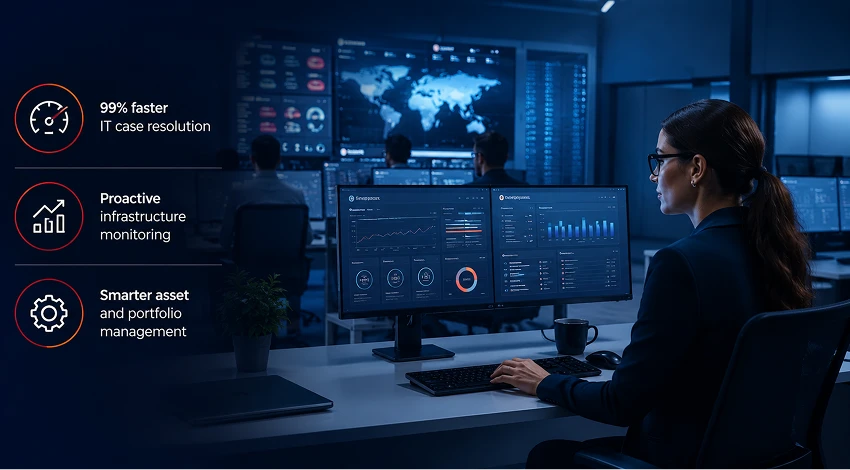
Autonomous CRM: Bridging the Gap Between Front-Office Interaction and Back-Office Fulfillment
Traditional CRM systems have historically functioned as passive repositories for tracking sales activities and logging service interactions, failing to fulfill actual underlying customer requests. When customers attempt to dispute a charge, expedite an order, or request a custom quote, the enterprise often struggles within the disconnect between front-office engagement and back-office execution. Ipsos research highlights this operational friction, revealing that sales representatives spend a mere 10 hours per week directly interacting with customers. Furthermore, ServiceNow’s own CX Shift research notes that service agents typically must navigate three to five separate systems to resolve a single customer issue, losing the remainder of their time to administrative overhead and manual handoffs.
The introduction of Autonomous CRM aims to eliminate this systemic friction by completing the actual work required across the customer lifecycle. ServiceNow introduced new AI specialists dedicated to sales qualification, custom quoting, order fulfillment, invoice disputes, general service, and account renewals. Within case management, these digital agents triage, resolve, and escalate customer issues across multiple communication channels, and can even generate tailored quotes directly from meeting transcripts. The underlying scale of this infrastructure is already significant; ServiceNow's platform currently resolves over 100 million customer cases, orchestrates more than 16 million orders, and configures over seven million quotes each month. The new specialists accelerate this baseline, providing faster resolution times and direct execution.Employee Services: Deploying a Digital Workforce for Core Business Functions
Human resources, finance, legal, procurement, and workplace services teams consistently battle structural hurdles stemming from rising case volumes and service desks dependent on manual triage. ServiceNow estimates that approximately 23 million employees utilize its employee portal every month, generating more than 40 million cases annually. Managing this massive volume of routine, highly repeatable work manually consumes considerable corporate resources.
To automate these processes, ServiceNow introduced role-specific AI specialists across HR, legal, finance, procurement, workplace services, supplier management, and health and safety. Functioning effectively as digital employees equipped with specific business skills, these specialists have demonstrated the ability to resolve 91% of cases without requiring human reassignment across ServiceNow's customer base. By deflecting requests before they mature into formal cases and routing existing tickets directly to the appropriate digital specialist, the platform frees human business operations teams to focus on high-value initiatives such as workforce planning, contract negotiations, supplier strategy, and macro financial planning.Security and Risk: Containing Emerging Threats in Minutes
Enterprise security operations and risk management teams find themselves structurally overwhelmed. Vulnerabilities accumulate faster than teams can manually triage them a challenge further accelerated by AI-driven attack surface expansion. Phishing attempts require immediate cross-tool investigations, yet manual verification and response workflows routinely stretch resolution times from minutes to hours. Legacy point solutions are fundamentally unequipped to maintain pace with the velocity of modern digital platforms.
The new Autonomous Security & Risk solution introduces specialized AI digital agents engineered to clear expanding backlogs across the entire enterprise threat landscape. These specialists autonomously triage and remediate hardware-level and software vulnerabilities, investigate Security Operations Center (SOC) incidents with humans-in-the-loop, and screen third-party vendor risks to deliver instant compliance summaries. By compressing security tasks that traditionally required days or hours down to mere minutes, the solution unifies cyber asset intelligence, identity visibility, operational governance, and autonomous security response on a single, shared architecture.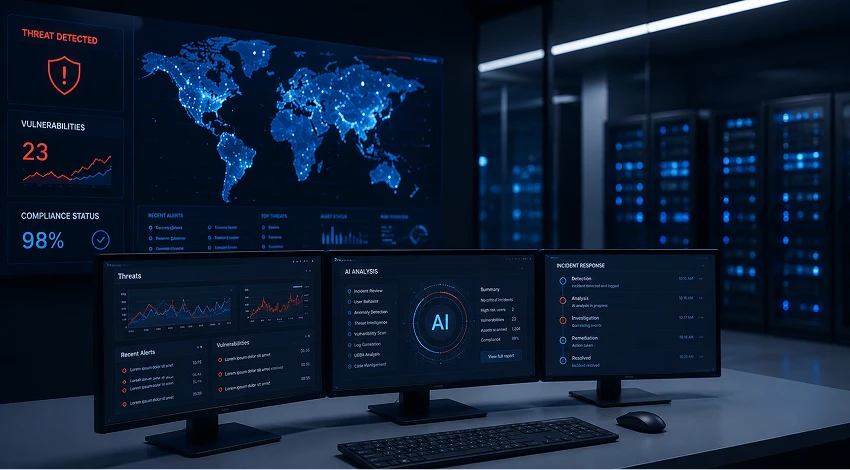
Platform Governance and Open Ecosystem Integration
A critical differentiator of the expanded Autonomous Workforce is that all AI specialists operate natively on a single unified architecture. Rather than functioning as isolated, third-party add-ons, these digital workers share the identical operational intelligence layer. This includes the Configuration Management Database (CMDB), the Workflow Data Fabric with Context Engine, the conversational front door via ServiceNow EmployeeWorks, and centralized oversight through the AI Control Tower. ServiceNow built these capabilities directly into every product and package by default, allowing organizations to build upon existing platform investments without increasing architectural complexity or extending time-to-value.
To facilitate deployment across existing corporate infrastructures, ServiceNow expanded its delivery ecosystem through strategic partnerships with Amazon Web Services (AWS), Google Cloud, Microsoft, and NVIDIA. These collaborations allow AI specialists to operate seamlessly across the infrastructure frameworks that enterprises already utilize. Furthermore, ServiceNow AI specialists can integrate third-party technologies, including the NVIDIA Agent Toolkit software which features the NVIDIA AI-Q Deep Research specialist agent blueprint utilizing a strategic combination of both open and closed AI models.What Should Organisations Do Now?
For CIOs, architects, and digital transformation leaders looking to transition from basic task-automation to a fully governed, autonomous workforce, the following structured actions are recommended:
- Audit Operational Backlogs and Triage Bottlenecks: Identify the specific functional areas whether in IT incident backlogs, CRM manual handoffs, or routine HR case routing where human talent is heavily consumed by repeatable administrative tasks.
- Establish Unified Platform Governance: Work closely with existing cloud and technology partners (such as AWS, Google Cloud, Microsoft, or NVIDIA) to ensure infrastructure readiness for hosting and running role-scoped AI specialists natively.
- Map Rollout Timelines to General Availability: Align organizational implementation roadmaps with ServiceNow's release schedule: deploy currently available L1 IT, CRM, and Employee Service specialists immediately; prepare for IT specialists in June 2026; and plan for Security and Risk previews in June 2026 ahead of general availability in September 2026.
The transition to an Autonomous Workforce represents a fundamental shift in how modern enterprises orchestrate labor and technology. By embedding role-scoped, governed AI specialists directly into a unified workflow fabric, organizations can effectively eliminate operational backlogs while elevating human employees to focus exclusively on strategic growth, governance, and creative problem-solving.