Supply Chain Fragility: Using ServiceNow to Predict Vendor Failure Before It Hits Your Balance Sheet
If the disruptions of the 2020s taught enterprise leaders anything, it’s that your balance sheet is only as resilient as your weakest supplier. When a critical vendor faces financial distress, a cyber breach, or a regional logistical failure, the ripple effect reaches your operations in hours. By the time an official supplier insolvency notice hits your desk or an ERP system flags a missed delivery, the financial damage is already done. Revenue forecasts tank, emergency re-routing costs skyrocket, and the balance sheet takes a massive, reactive hit.
For Chief Procurement Officers (CPOs), CFOs, and Supply Chain directors, relying on backward-looking ERP metrics or annual risk spreadsheets is no longer viable.Midway through 2026, forward-thinking enterprises are shifting from reactive recovery to predictive mitigation. Powered by ServiceNow’s Zurich and Yokohama releases, organizations are leveraging the ServiceNow AI Platform to identify, analyze, and neutralize vendor vulnerabilities before they trigger an operational crisis.The Blind Spot in Modern Supply Chains
Most organizations treat supply chain risk management as a disconnected, periodic exercise. Procurement runs credit checks during onboarding, IT Security conducts an annual cyber audit, and Operations flags delayed shipments inside the ERP.
The problem? These systems don’t talk to one another in real time.An ERP tracks transactional historical data it tells you that a shipment is late today. It cannot tell you that three weeks ago, a critical third-party component manufacturer suffered a severe ransomware attack or underwent a dramatic credit downgrade.ServiceNow eliminates this blind spot by serving as the connective AI Platform across your entire vendor ecosystem, uniting isolated data streams into a single, proactive operational command center.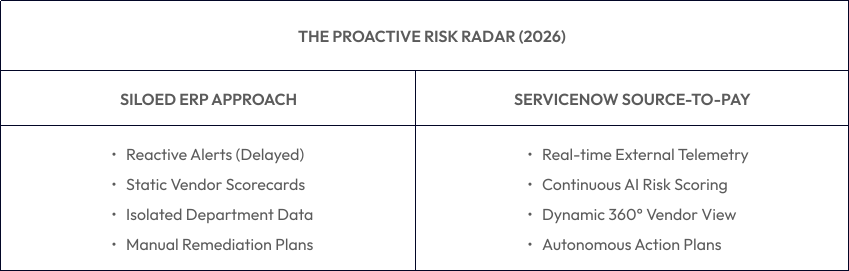
The 2026 Architectural Defense: Source-to-Pay and TPRM
ServiceNow’s unified data architecture allows enterprises to seamlessly merge operational workflows with predictive hazard detection. The platform relies on three key modules within the Source-to-Pay and Integrated Risk Management (IRM) suites to secure supply chains:
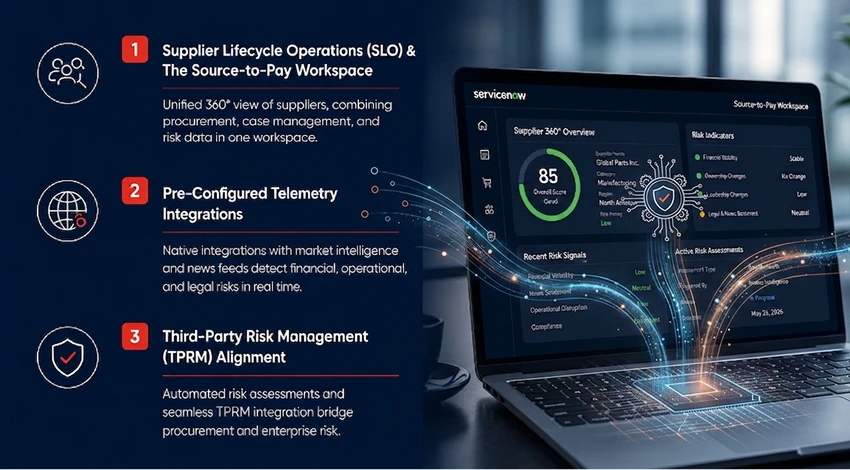
Supplier Lifecycle Operations (SLO) & The Source-to-Pay Workspace
In the Zurich release, ServiceNow has consolidated the entire supplier management lifecycle. Through a centralised Source-to-Pay Workspace, supplier managers get a true 360-degree relationship visualisation. This workspace combines internal procurement metrics, supplier case management histories, and external data feeds into a unified dashboard, ensuring that operational performance data is never decoupled from risk metrics.
Pre-Configured Telemetry Integrations (Craft.co & News Feeds)
Rather than relying on manual audits, ServiceNow’s modern ecosystem actively pulls external intelligence directly into your workflow. Native integrations with market intelligence platforms like Craft.co and pre-configured financial/news pipelines (such as Microsoft Bing) continually monitor your vendors. If a critical supplier exhibits financial volatility, ownership shifts, leadership churn, or negative legal sentiment, the system catches it instantly.
Third-Party Risk Management (TPRM) Alignment
Through native application store integrations, Supplier Lifecycle Operations connects smoothly with the Third-Party Risk Management (TPRM) application. When external monitoring engines flag a risk, ServiceNow automatically initiates smart, automated risk assessments based on the vendor's criticality. This bridges the historical gap between procurement operations and corporate risk management.
From Insight to Action: Activating Autonomous AI Specialists
The defining shift of 2026 is that ServiceNow doesn't just notify you of a potential supplier failure it builds your operational defense plan automatically.
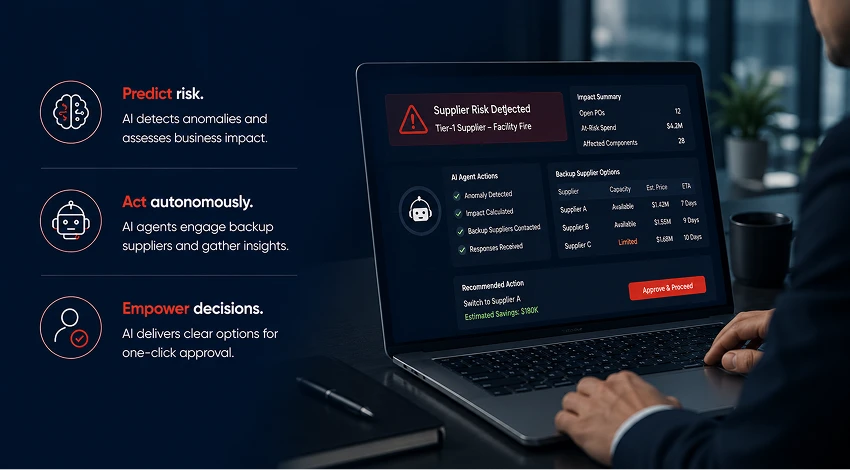
Leveraging generative AI capabilities via Now Assist for Sourcing and Procurement Operations (SPO) alongside autonomous AI Agents , the platform changes how risk is handled:- Predictive Intelligence & Triaging: When an external telemetry stream flags an anomaly (e.g., a tier-1 electronic component supplier suffers a major facility fire), ServiceNow’s Predictive Intelligence engine calculates the business impact by reviewing open purchase requests and bills of materials across your instance.
- Autonomous Agent Engagement: A specialized AI Agent initiates a priority case within the Supplier Workspace. The agent uses Now Assist to draft precise, context-aware emails to alternative, pre-vetted backup suppliers to verify their capacity and pricing.
- Human-in-the-Loop Orchestration: The AI Agent packages the entire situation the flagged vendor issue, the impacted business workflows, and a selection of instantly available alternate options into a clean digital brief. It presents this to the procurement manager (the human "Controller") via the workspace for one-click approval.
Protecting Your Bottom Line
Supply chain fragility is an operational certainty, but suffering financial loss because of a vendor collapse is entirely preventable.
By anchoring your supplier networks in ServiceNow Supplier Lifecycle Operations and Third-Party Risk Management, you stop managing supply chains through the rearview mirror. You grant your organization the ability to spot operational anomalies early, switch lanes smoothly, and protect your balance sheet long before a disruption ever manifests in the real world.