ServiceNow ROI in a Recessionary Climate: How to Do More with 20% Less Staff
When macroeconomic headwinds stiffen and a recessionary climate takes hold, the executive mandate from the C-suite is as predictable as it is painful: slash operational expenses immediately. Historically, this translates to a headcount reduction of roughly 20% across IT, HR, and customer service departments.
But here is the catch that distinguishes modern recessions from those of the past: while your staff headcount decreases by 20%, your volume of inbound service tickets, system complexities, and customer demands does not scale down with it. In fact, understaffed organizations often see a spike in operational friction, system downtime, and employee burnout. For Chief Information Officers (CIOs) and Chief Financial Officers (CFOs), the old playbook of "surviving the crunch" by simply telling remaining workers to hustle harder is a fast track to systemic failure. To thrive, organizations must pivot from defensive cost-cutting to aggressive platform optimization. The secret weapon to squeezing frontier-level productivity out of a leaner workforce isn't a new line-item expense it is maximizing the return on investment (ROI) of the core platform you already own: ServiceNow. Enhanced by the native automation and AI architectures of the Xanadu and Zurich releases, ServiceNow is helping enterprises turn a 20% staff reduction into a masterclass in operational efficiency.The Core Math of a Leaner Workforce
To understand how to do more with less, we have to look closely at where a remaining team's time actually goes. In a standard, unoptimized IT environment, up to 70% of an engineer's day is consumed by what site reliability engineers call "toil." This includes repetitive, low-value manual tasks like validating access permissions, resetting cloud sandbox instances, manually routing tickets based on incomplete descriptions, and copying data between disconnected tracking systems.
When you lose 20% of your staff, your organization cannot afford to waste a single remaining human hour on toil. Human bandwidth must be preserved exclusively for high-value architecture, strategy, and critical exception management.ServiceNow systematically eliminates this toil, acting as a force multiplier that allows a downsized team to comfortably absorb and manage a larger operational volume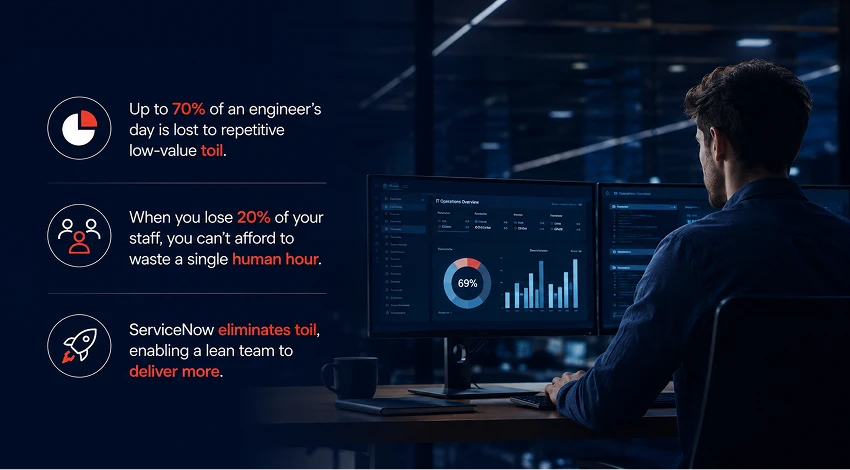
3 Core Pillars to Extracting Rapid ServiceNow ROI During a Crunch
During a recession, you don't have 12 months to wait for a complex, customized implementation. You need to unlock platform value instantly. The current platform features allow organizations to drive immediate efficiency through three distinct architectural pillars:
Activating the Autonomous Digital Worker (Now Assist & Agent Studio)
The single fastest way to compensate for lost headcount is to transition your remaining staff from task creators and executors to strategic supervisors. Through AI Agent Studio, ServiceNow allows teams to deploy autonomous AI Specialists directly into your IT Service Management (ITSM) and Customer Service Management (CSM) work streams.
These digital workers do not just chat with users; they execute entire workflows end-to-end without a human click. For example, when an incident regarding an application access failure is logged, an autonomous agent interprets the context, queries security access groups via secure spokes, verifies corporate compliance, provisions the access token, and resolves the ticket. By letting AI specialists handle routine, high-volume requests autonomously, a smaller team can easily scale its output without facing operational bottlenecks.Consolidating the Tech Stack on a Single Platform Architecture
In periods of economic expansion, organizations frequently suffer from "tool sprawl." Separate departments buy point-solutions: one tool for HR document management, another for facilities tracking, a different platform for third-party risk, and a legacy software asset manager. Every single one of these disparate platforms carries separate licensing costs, heavy integration maintenance overhead, and siloed data.
A recession is the ideal time to ruthlessly consolidate these tools onto the unified ServiceNow data architecture. By migrating legacy applications into native ServiceNow modules such as moving vendor audits into Third-Party Risk Management (TPRM) or tracking corporate carbon footprints through Operational Sustainability Management you eliminate external license fees, slash maintenance costs, and grant your downsized team a single, cohesive command center to manage the entire enterprise footprint.Turning off the Toil Engine via Strategic Process Mining
When staffing numbers decrease, you must fix hidden operational bottlenecks before they turn into major delays. ServiceNow’s native Process Mining engine continually runs in the background, analyzing the actual path your tickets and workflows take right where they run.
Instead of hiring expensive external consultants to audit your business, ServiceNow automatically surfaces visual bottleneck maps. It highlights exactly where tickets are bouncing between teams, which manual approval steps are stalling workflows, and which service portal items are driving the most human effort. Armed with these insights, platform managers can quickly tune workflows, eliminate redundant steps, and streamline the path to resolution.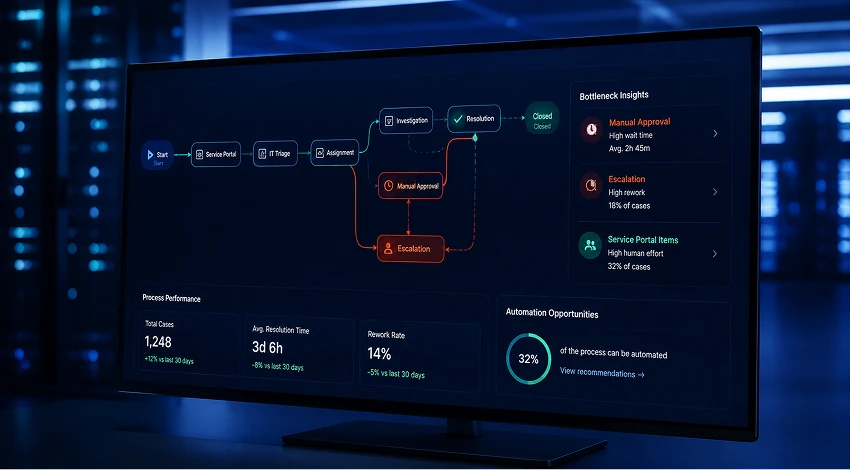
The Strategic Reality: The Control Tower Pivot
Maintaining high operational performance during an economic downturn is entirely achievable, provided you shift your relationship with technology. The goal isn't to force your remaining employees to work 20% faster; the goal is to eliminate 80% of the manual steps they have to take.
By leveraging the full capability of the ServiceNow platform, you establish a resilient, self-healing digital ecosystem. Your remaining human experts stop logging into disparate consoles to copy data or execute repetitive scripts. Instead, utilizing the ServiceNow AI Control Tower, they set the operational guardrails, monitor automated pipelines, and manage the exceptions of a highly efficient digital workforce.A recessionary climate demands absolute operational discipline. By maximizing your ServiceNow ROI, you don't just survive the budget cuts you build a lean, highly automated, and fiercely competitive enterprise that is ready to dominate the market the moment the economic tide turns.