Solving the Execution Gap: ServiceNow Unveils "Otto" to Unify Conversational AI and Deterministic Workflows
Enterprise artificial intelligence has run into a critical completion problem. While the tech industry has rapidly shipped large language models and point-solution AI helpers bolted inside isolated SaaS applications, these deployments remain siloed. They can summarize long documents or answer basic questions, but they lack the structural ability to execute multi-step operations across different departments or external backend systems. Because these standalone models are disconnected from verified corporate platforms, they operate without native visibility into permission layers, organizational charts, approval matrices, or auditable compliance tracks. Consequently, employees find themselves caught in the same old routine: juggling different applications, manually chasing down management approvals, and routing their own service requests. This friction limits overall productivity gains while driving up enterprise technology costs.
To bridge this operational disconnect, ServiceNow has introduced ServiceNow Otto, a centralized enterprise AI experience designed to turn conversational intent into fully executed workflows. Unveiled at the annual Knowledge 2026 conference, this framework brings together the structural intelligence of Now Assist, the conversational capabilities of Moveworks, and advanced design principles. Rather than operating within a single, isolated application boundary, the solution acts as a cross-departmental orchestration layer. It interprets natural language commands and executes tasks to completion by working through the platform's established governance layers, shielding employees from the underlying structural complexity of backend legacy environments.The Multi-Channel Architecture of ServiceNow Otto
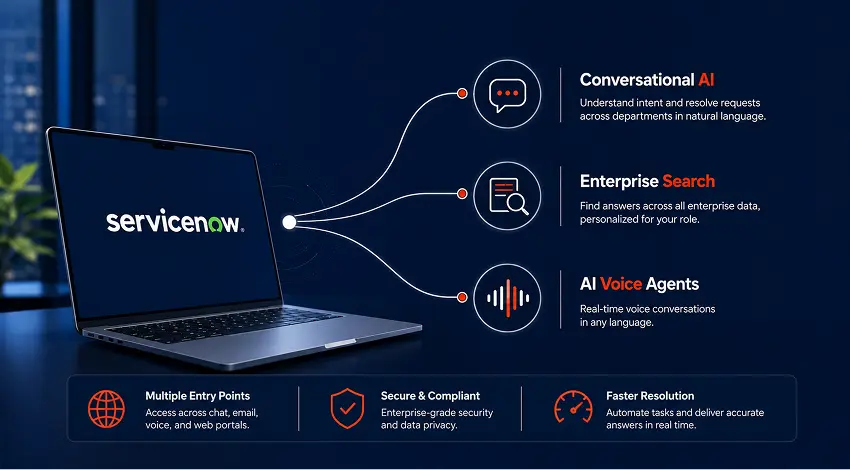
The framework coordinates multi-modal interactions across separate corporate entry points while driving automated execution through four key platform pillars:
- Conversational AI: Enables employees, partners, and customers to submit complex operational requests via natural business English. The engine is engineered to identify user intent and resolve tasks across multiple departments without forcing the user to switch tools or manually navigate siloed portals.
- Enterprise Search: Scans structured and unstructured data repositories including local files, corporate wikis, centralized databases, and Microsoft SharePoint to deliver direct answers that are dynamically personalized based on the user's explicit role, geographic location, and department.
- AI Voice Agents: Manages real-time verbal inquiries through natural conversations across multiple languages, bypassing legacy phone menus, complex interactive voice response (IVR) tree structures, and long telephony hold queues.
- AI Data Explorer: Allows business analysts and corporate leaders to query deep enterprise operational data using standard plain language, automatically returning complex analytical insights and comprehensive data summaries.
Bridging Front-Office Intent and Back-Office Execution
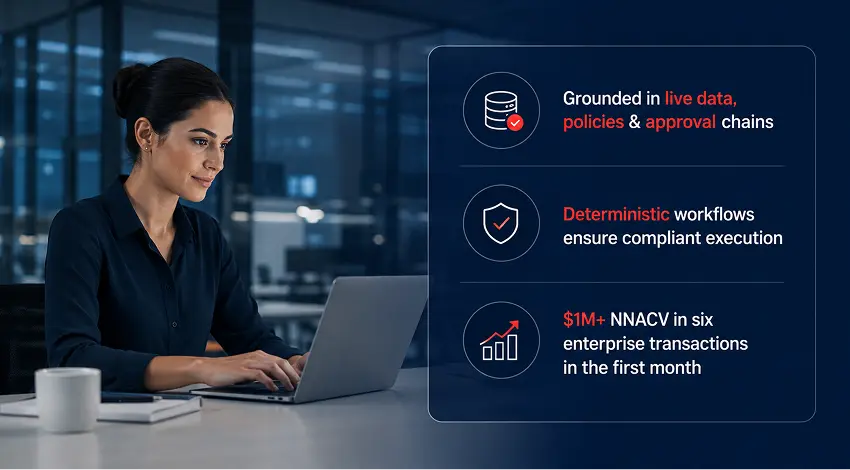
The rollout of the new architecture begins natively within ServiceNow EmployeeWorks and the centralized AI Control Tower framework. This deep alignment guarantees that every automated action is grounded in a company's specific live datasets, documented policies, and management approval chains. By routing conversational requests directly through a deterministic workflow layer, the platform prevents the common problem of AI hallucinations, ensuring that transactions move faster while strictly adhering to corporate compliance rules.
The financial performance of early deployments highlights significant market demand for this unified execution approach. Within just one month of its initial market launch, ServiceNow EmployeeWorks generated six distinct enterprise transactions exceeding $1 million each in net new annual contract value (NNACV). These initial milestones demonstrate that enterprise technology buyers are prioritizing generative AI investments that move beyond simple chat summaries, favoring architectures that offer verifiable execution grounded in actual organizational contexts.Continuous Oversight via the ServiceNow AI Control Tower
As autonomous execution spreads across various business units, maintaining absolute operational visibility becomes vital for risk and compliance managers. Every interaction, data query, and automated transaction managed by ServiceNow Otto is continuously supervised through the ServiceNow AI Control Tower. This architecture enforces standard corporate security policies, blocks unauthorized data access, and maintains absolute transparency by logging a clear, explainable audit trail for every automated decision.
The business value of this centralized oversight is reflected in its rapid adoption by global scale organizations. With more than 100 billion workflows running on the ServiceNow AI Platform each year, the integration of a unified conversational agent provides technology leaders with a single pane of glass. This setup connects digital intelligence with strict back-end execution, transforming fragmented departmental systems into highly coordinated, auditable digital processes.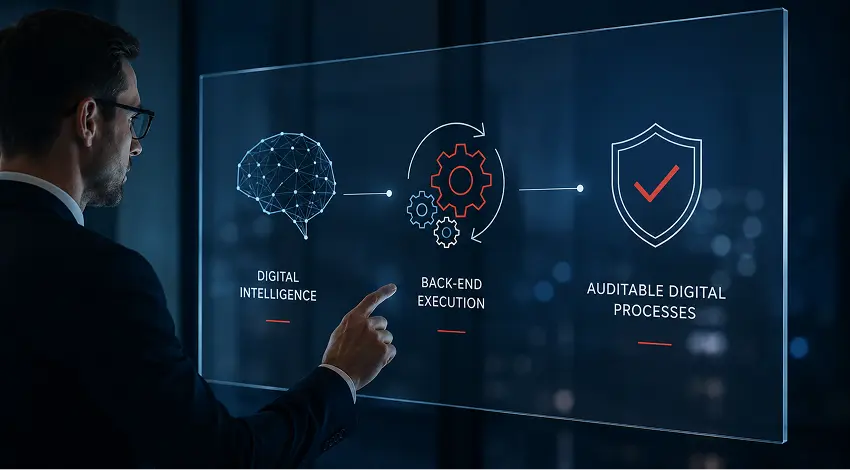
What Should Organisations Do Now?
To move beyond experimental AI pilots and prepare core technical infrastructure for a unified conversational execution model, enterprise technology leaders should adopt the following strategies:
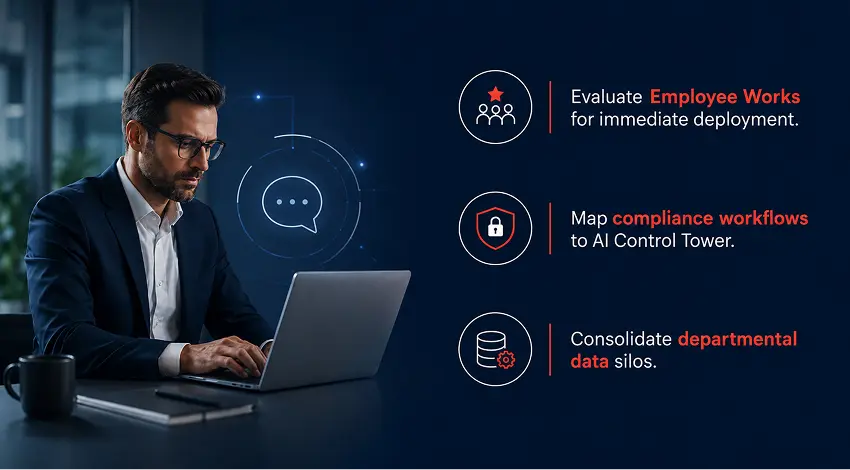
- Evaluate Employee Works for Immediate Deployment: Review current employee service delivery channels to leverage ServiceNow EmployeeWorks as the initial launchpad for conversational AI and unified enterprise search.
- Map Compliance Workflows to AI Control Tower: Align internal corporate risk, security, and identity management teams to configure the AI Control Tower, ensuring enterprise data permissions and approval gates are enforced prior to wider rollouts.
- Consolidate Departmental Data Silos: Audit and clean internal documentation, localized wikis, and Microsoft SharePoint repositories, as the enterprise search engine relies on these data pools to generate role-specific answers.
- Prepare Infrastructure for Multi-Modal Expansion: Review existing service desk channels and telephony setups to accommodate the incoming multi-lingual AI Voice Agents and natural language AI Data Explorer tools as the platform expands in the year ahead.
Conclusion
The introduction of ServiceNow Otto represents a permanent shift away from isolated generative AI utilities toward fully governed, cross-system automation. By embedding conversational intelligence into a deterministic platform architecture, modern enterprises can systematically remove manual administrative steps and eliminate the friction of switching between applications. As this unified experience rolls out across the entire portfolio over the coming year, organizations that ground their conversational interfaces in strict enterprise compliance workflows will achieve a distinct advantage in operational speed and organizational efficiency.