Small Language Models (SLMs) on ServiceNow: Why "Smaller" is "Smarter" for Secure Financial Services
For the past few years, the corporate world has been operating under a "bigger is better" mindset regarding Generative AI. Boards and IT leaders chased massive, multi-hundred-billion-parameter Large Language Models (LLMs) hosted in public clouds.
But in the Financial Services, Banking, and Insurance (BFSI) sectors, that brute-force approach has hit a wall. Between stringent compliance mandates (like DORA, SEC guidelines, and GDPR), skyrocketing cloud consumption costs, and the risk of sensitive financial data leaking into public training sets, financial institutions cannot afford the unpredictability of generic public LLMs.Fortunately, mid-2026 has brought a massive paradigm shift. Powered by ServiceNow’s latest platform advancements through the latest releases, the industry is discovering that "smaller" is actually "smarter." With Ripton Solutions, understand that by leveraging Small Language Models (SLMs) directly within the ServiceNow AI Platform, financial institutions are achieving frontier-level reasoning, hyper-targeted domain accuracy, and ironclad security all on a fraction of the digital footprint.What is an SLM, and Why Does It Matter for Finance?
Unlike generalized LLMs trained on the entire public internet, Small Language Models typically range from 1.5 billion to 30 billion parameters. Crucially, they are pre-trained and fine-tuned on highly specialized, clean, domain-specific datasets.
Think of a massive public LLM as a general practitioner doctor, and an SLM as an elite cardiothoracic surgeon. If you need a specialized financial workflow executed securely, you don’t need a model that knows how to write screenplay scripts or explain medieval history; you need a model that understands ledger reconciliation, fraud telemetry, and sovereign compliance.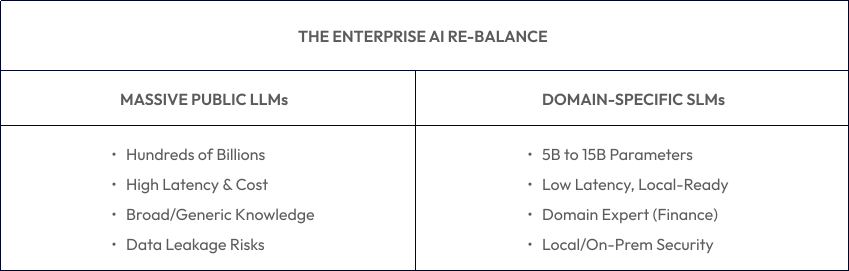
The ServiceNow Technical Reality: Meet the "Apriel" SLM Family
ServiceNow has quietly established itself as a pioneer in enterprise-grade language models through its SLAM Labs (ServiceNow Language Models Labs) initiative. Rather than forcing banks to rely solely on massive external APIs, ServiceNow has introduced local, hyper-efficient options built natively for enterprise workflows:
Apriel 5B: The Enterprise Workhorse
Released to drive resource-efficient intelligence, Apriel 5B is a 4.8-billion-parameter model designed explicitly for fast, high-volume automation. It excels at processing internal knowledge assistants, drafting compliant regulatory responses, and executing domain-specific customer support tasks in Financial Services Operations (FSO) without staggering GPU bills.

Apriel 1.6 15B Thinker: The Vision-Language Reasoning Master
The jewel of the 2026 SLM lineup is the Apriel 1.6 15B Thinker. Despite sitting at a compact 15 billion parameters (meaning it can easily fit on a single, localized GPU), it punches far above its weight class. It is a multimodal reasoning model that matches the performance of models 15 times its size on tool usage and function calling. For a bank, this means an AI agent can simultaneously audit a scanned corporate balance sheet (image) and match it against an incoming transaction log (text) in real time.
3 Reasons Why SLMs Are Winning Secure Financial Services in 2026
Zero-Trust Data Privacy and Local Sovereignty
In banking, data cannot cross certain boundaries. Because ServiceNow’s Apriel models are fully open and optimized for resource-constrained deployments, financial institutions can host them locally or within sovereign cloud perimeters. Your customer's personal identifiable information (PII) and portfolio data never leave your secure ServiceNow environment, completely neutralizing data-leakage and compliance risks.
Native "Tool Wielding" via Agentic Workflows
The true value of AI in 2026 isn't a chatbot that gives text answers it's an agent that takes action. The Apriel 1.6 Thinker is purpose-built for tool usage. When integrated with AI Agent Studio and ServiceNow Otto™, these SLMs don't just summarize a billing dispute; they autonomously navigate subflows, query core banking systems via secure REST APIs, and update customer files all while adhering to strict natural-language guardrails managed by the ServiceNow AI Control Tower.
Predictable Cost and Hyper-Speed Performance
Massive LLMs are notorious for high latency and unpredictable consumption pricing. Because SLMs activate far fewer parameters per token, they operate at lightning speed. By shifting routine, high-volume finance workflows such as accounts payable operations, loan documentation triaging, and Know Your Customer (KYC) compliance tracking to localized SLMs, financial firms see a massive drop in compute costs and a drastic increase in processing speeds.
The Hybrid Approach: Orchestrating the Future
Does the rise of SLMs mean large models are completely dead? Not at all.
Leading financial institutions in 2026 are deploying a hybrid AI architecture. Under this model, efficient, localized SLMs handle 85% of daily transactional workloads, customer inquiries, and automated compliance auditing. If a case requires deep, cross-domain creative reasoning or fall-back exception processing, the system safely routes that specific query to a larger model ensuring the optimal balance of speed, cost, and safety.Moving Forward Securely
The enterprise AI race has evolved past the hype of massive model sizes. In the highly regulated world of financial services, success belongs to those who deploy precise, secure, and highly actionable intelligence.
By leveraging ServiceNow’s native SLM breakthroughs like the Apriel series, your financial institution can unlock the full power of an autonomous digital workforce without compromising on compliance, cost, or security.