Quantum-Resistant ServiceNow: Is Your Encryption Ready for the Next Decade of Cyber Threats?
For years, enterprise cybersecurity has relied on a comfortable mathematical truth: the asymmetric encryption algorithms safeguarding our digital assets like RSA and Elliptic Curve Cryptography (ECC) would take standard silicon computers hundreds of thousands of years to crack.
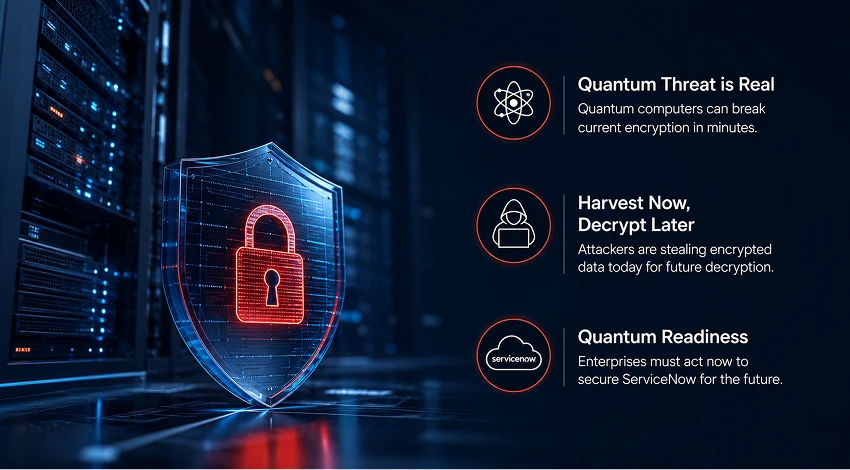
But as we hit the midway point of 2026, that comfortable truth is rapidly evaporating. We are fast approaching the era of the Cryptanalytically Relevant Quantum Computer (CRQC). Unlike traditional computing architectures, a mature quantum computer utilizes qubits to process highly complex parallel equations simultaneously. This means the very mathematical barriers shielding your most sensitive cloud data today could be dismantled in minutes. Cybercriminals know this, which is why they are actively executing "Harvest Now, Decrypt Later" (HNDL) attacks stealing encrypted enterprise data today with the intention of unlocking it the moment quantum computing matures. If your enterprise relies on ServiceNow as its core operational data engine, you cannot afford a "wait-and-see" approach. With ServiceNow highlighting that many enterprises remain dangerously unprepared for quantum leaps in computing, the conversation has officially shifted. Driven by recent structural shifts in the platform's Xanadu and Zurich releases, achieving Quantum Readiness is no longer a compliance roadmap item it is an immediate operational requirement.The Core Threat: Symmetric vs. Asymmetric Risk
To understand how to protect your instance, you must look closely at how quantum mechanics impacts different encryption frameworks:
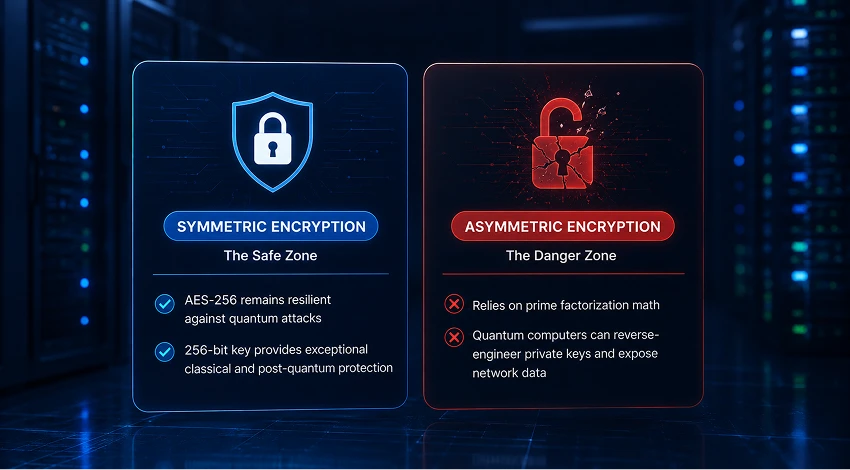
- Symmetric Encryption (The Safe Zone): Mechanisms like AES-256 (Advanced Encryption Standard), which protect data at rest, remain remarkably resilient against quantum attacks. The National Institute of Standards and Technology (NIST) confirms that maintaining robust 256-bit symmetric key sizes provides an exceptional level of classical and post-quantum protection.
- Asymmetric Encryption (The Danger Zone): Systems used to wrap keys, establish TLS handshakes, and manage external key exchanges are highly vulnerable. Because they rely on prime factorization math, a quantum computer can easily reverse-engineer the private keys, exposing the data flowing across your network.
The 2026 Architectural Defense: Vault, KMF, and Australia Releases
ServiceNow has quietly established a highly robust, crypto-agile framework designed to absorb the post-quantum cryptography (PQC) migration seamlessly. The platform leverages three key pillars to secure your operational data:
The Australia Release: Quantum-Resistant EKM Architecture
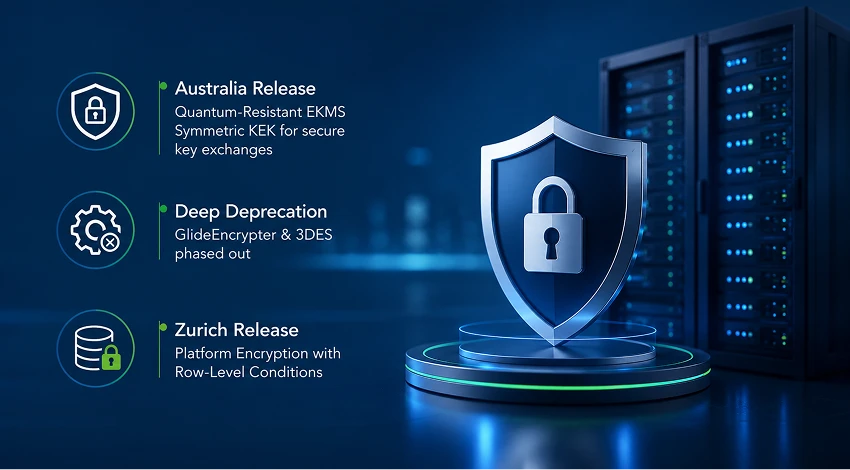
A major milestone in ServiceNow's long-term security roadmap is the rollout of a quantum-resistant architecture for the External Key Management System (EKMS), finalized in the Australia release family. This breakthrough update completely eliminates the platform's reliance on vulnerable asymmetric algorithms for external key handshakes. Instead, it leverages a specialized symmetric Key Encryption Key (KEK) to safely wrap and transfer your local Data Encryption Keys (DEKs), providing ironclad defense against intercept-and-decrypt threats.
Deep Deprecation of Legacy Cryptography
Crypto-agility requires aggressively purging legacy weak spots. In recent platform rollouts, ServiceNow has initiated a comprehensive deprecation of the older GlideEncrypter script architecture and 3DES algorithms. Newly provisioned instances completely block these outmoded cryptographic processes, while upgraded instances log any remaining dependencies straight to the sys_audit table, ensuring your core database is wiped clean of pre-modern encryption vulnerabilities.
Zurich Release: Precision Platform Encryption and Row-Level Conditions
Data protection must be granular. The Zurich release introduces advanced updates to Platform Encryption (a critical component of the ServiceNow Vault suite). Moving beyond legacy column-level encryption, administrators can now enforce dynamic Row-Level Conditions. This allows an enterprise to encrypt individual rows within a shared table using entirely unique keys based on real-time organizational context. For instance, highly sensitive HR or intellectual property data can be shielded with custom-supplied keys via Cloud Encryption, while routine IT data in the same table relies on standard keys drastically reducing your aggregate blast radius.
Turning Risk into Action: Securing Your Instance Today
Migrating an entire global enterprise to absolute post-quantum resilience will take time, but the blueprint to establishing a proactive defense inside ServiceNow requires three immediate steps:
- Audit Your Encryption Posture: Utilize the ServiceNow Security Center to actively scan for incorrect security definitions, track your daily compliance trends, and identify where legacy custom scripts might still be using weak cryptographic calls.
- Leverage Platform Encryption Enterprise: Transition sensitive data fields and tables away from basic out-of-the-box configurations. Upgrade to Field Encryption Enterprise to implement custom Cryptographic Modules and enforce strict Module Access Policies (MAPs).
- Enforce Key Control (BYOK): Take definitive ownership of your data lifecycle. Utilize ServiceNow Cloud Encryption to supply and manage your own cryptographic keys, enabling instant rotation or revocation capabilities the moment an anomalous threat vector is detected.
The Strategic Bottom Line
Cybersecurity has entered a high-stakes transition period. The enterprises that will survive the next decade of advanced threats are not those waiting for a definitive "Q-Day" announcement to upgrade their systems. Success belongs to the organizations that embed proactive, crypto-agile principles directly into their operational workflows today.
By maximizing the native data security capabilities of the ServiceNow AI Platform, you do more than check a compliance box. You unbolt your enterprise from fragile legacy infrastructure, eliminate data-leakage vulnerabilities, and build a fiercely resilient, quantum-ready digital command center designed to protect your operational balance sheet for the next decade and beyond.