How to Control Your ServiceNow AI Budget Under Now Assist Metered Pricing
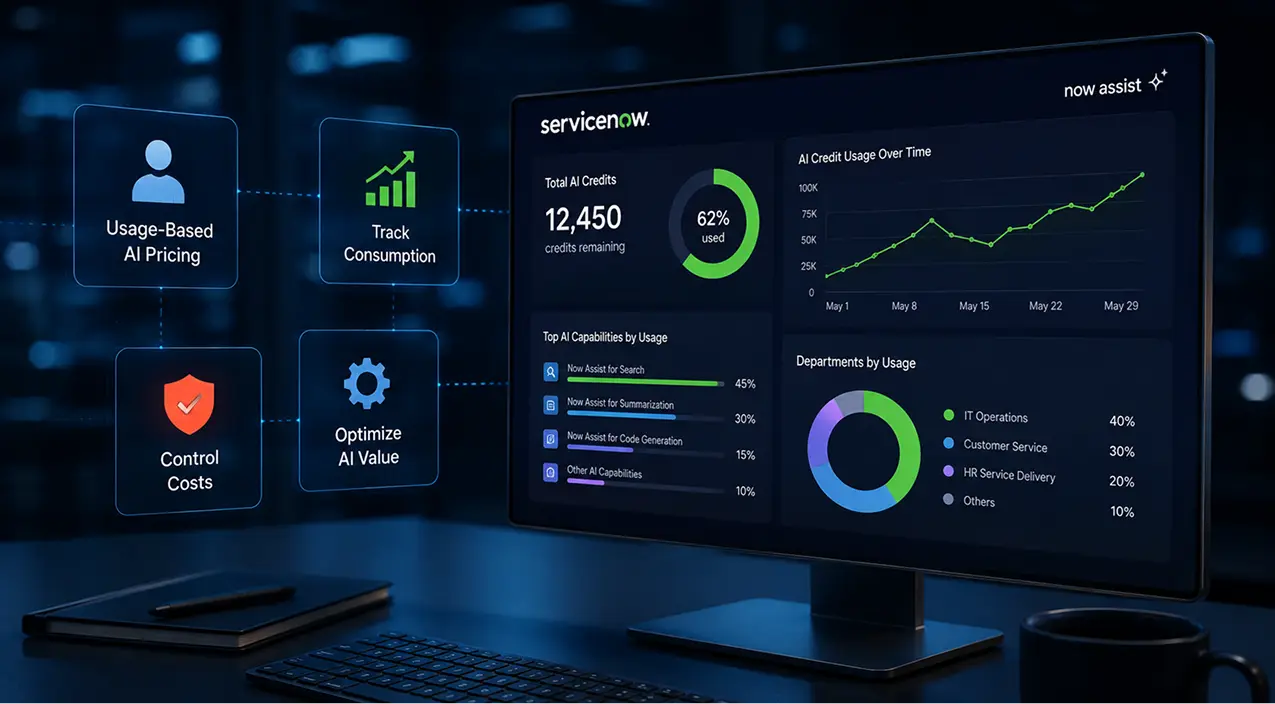
For years, enterprise software licensing relied on predictable, seat-based subscriptions you paid a fixed fee per user, regardless of whether that user triggered five workflows a day or five hundred. However, as Generative AI becomes embedded across enterprise operations, that traditional model is shifting fast. Understanding the business impact of Now Assist metered pricing ServiceNow budget strategies has quickly become a top priority for IT leadership, finance directors, and technology architects alike.
By transitioning from static user tiers to a consumption-driven credit framework, ServiceNow aligns cost directly with platform utility. In this breakdown, we analyze how this consumption pivot operates in practice, where hidden budget risks lie, and how enterprise leadership can turn consumption governance into a competitive advantage.Decoding the Shift: From Flat-Rate Seats to Assist Credits
To evaluate how this pricing evolution affects your organization's bottom line, we must first break down the mechanics of the consumption framework. Instead of charging a flat premium for every licensed desk agent, ServiceNow introduced a universal currency system centered around Assist Credits.
How Assist Credits Are Calculated
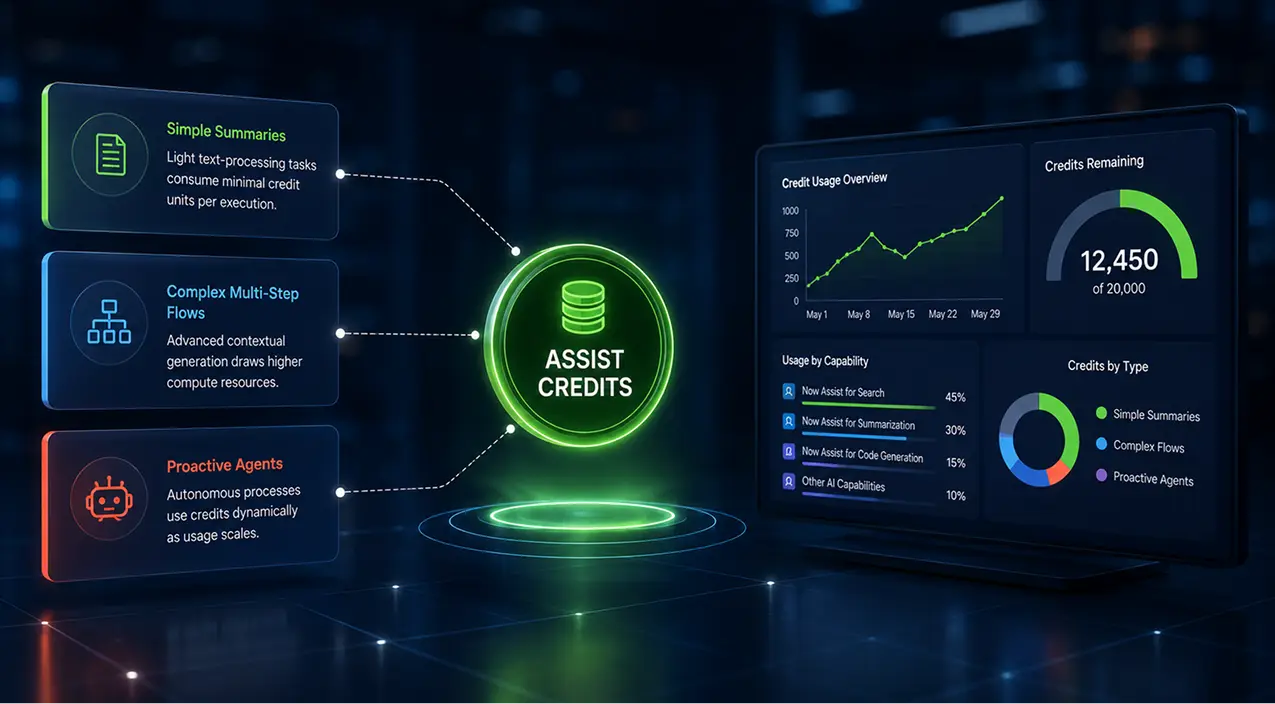
Every time an automated skill runs whether summarizing an Incident record, generating code snippets in App Engine, or running a virtual agent interaction a predetermined allocation of Assist Credits is consumed from your pool.
- Simple Summaries: Light text-processing tasks consume minimal credit units per execution.
- Complex Multi-Step Flows: Advanced contextual generation or multi-table record synthesis requires higher compute resources, drawing down credit balances faster.
- Proactive Agents: Autonomous processes that run continuously in the background can draw from your organization's credit pool dynamically as operational volume spikes.
Rather than penalizing overall adoption, this model ensures companies pay for the actual compute and intelligence value they harvest, rather than paying blanket fees for dormant accounts.
Strategic Budget Implications for Enterprise Executives
For C-suite leaders and finance teams managing enterprise technology investments, a metered consumption model brings both financial opportunity and budgeting complexity. Variable expense structures require proactive governance to avoid unexpected end-of-quarter budget overruns.
Shifting from CapEx Predictability to OpEx Visibility
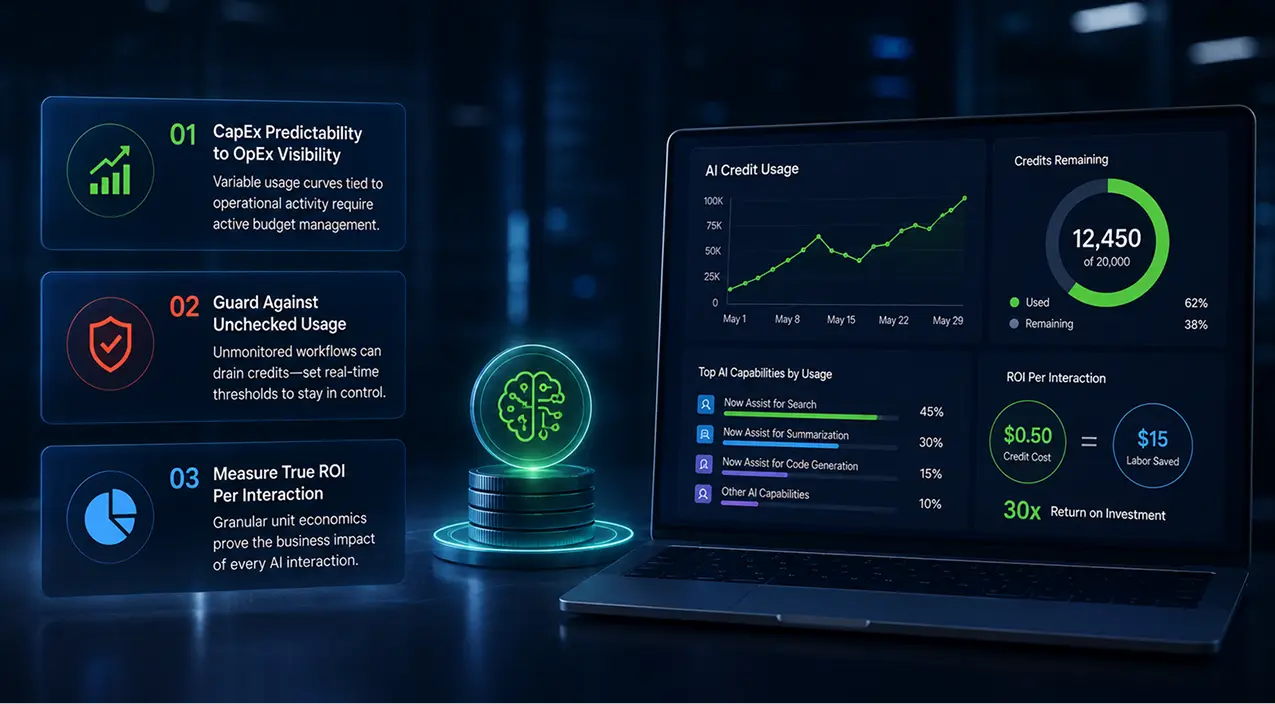
In fixed-seat licensing models, budgeting is straightforward: headcount multiplied by license cost. Consumption-based pricing introduces variable usage curves tied directly to operational activity. A sudden surge in IT service requests or customer support cases during peak quarters will naturally accelerate AI credit consumption.
Guarding Against Unchecked Autonomous Usage
Because Now Assist capabilities can be triggered automatically by virtual agents and system events, unmonitored workflows can quietly exhaust credit pools ahead of schedule. Technology leaders must establish real-time allocation thresholds to ensure high-priority business units retain access without exhausting enterprise-wide credit pools.
Measuring True ROI Per Interaction
The benefit of metered pricing is granular unit economics. Executives can evaluate whether spending $0.50 worth of credits on an automated resolution workflow saves $15 in tier-1 human support labor, giving teams clear, data-driven proof of return on investment (ROI).
Optimizing Now Assist Spend Across Multi-Cloud and AWS Environments
For enterprise architectures leveraging both ServiceNow and AWS, consumption management is a familiar operational discipline. AWS users who already manage cloud compute instances, serverless functions, and storage tiers can apply those exact cost-optimization playbooks to their ServiceNow AI workloads.
Implementing FinOps Disciplines for Enterprise AI
Just as FinOps teams analyze AWS CloudWatch logs to right-size EC2 instances, platform owners must audit Now Assist usage telemetry to eliminate wasted compute:
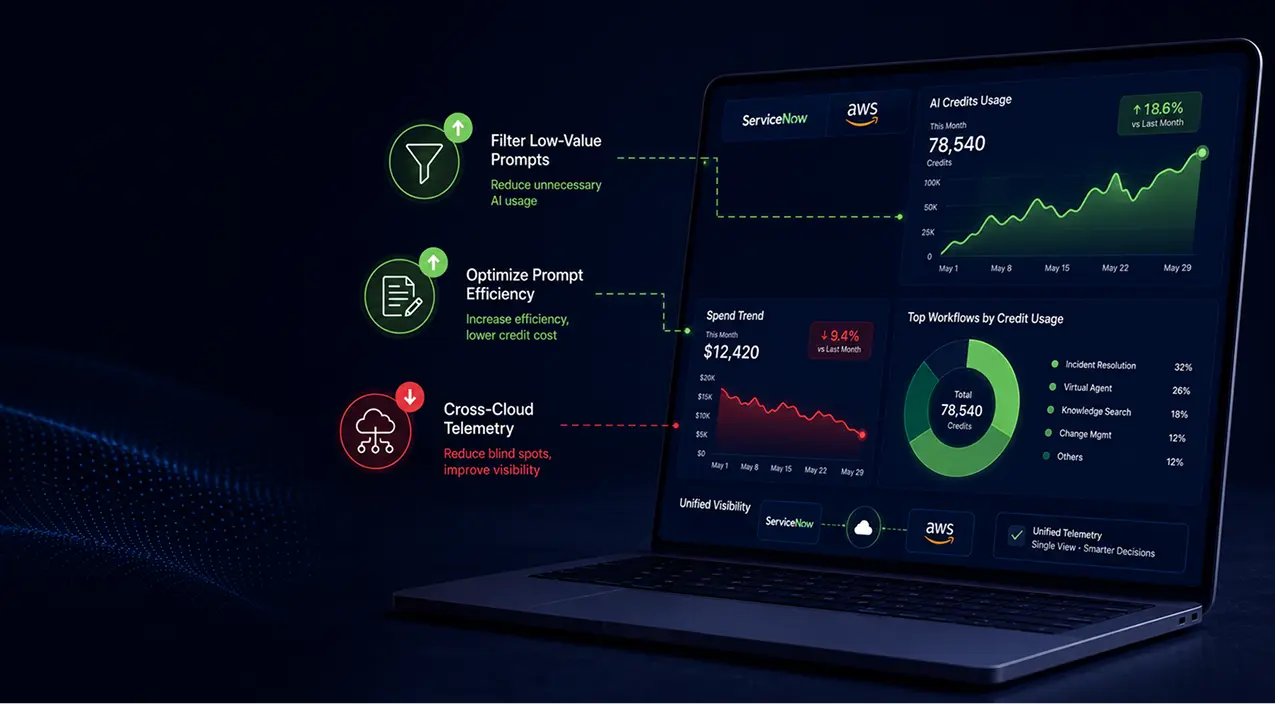
- Filter Low-Value Prompts: Restrict high-cost generative skills on low-priority ticket categories where standard, rule-based automation is sufficient.
- Optimize Prompt Efficiency: Standardize internal system prompts to minimize unnecessary token usage, reducing the total credit cost per transaction.
- Establish Cross-Cloud Telemetry: Align ServiceNow usage analytics with enterprise cloud spend tracking tools to gain a single-pane-of-glass view across AWS and ServiceNow AI infrastructure.
Key Takeaways
- Consumption-Based Framework: Now Assist uses a credit-based consumption model where fees correspond directly to AI model usage and task complexity.
- Proactive Budgeting Required: Fixed-seat predictability is replaced by variable consumption curves that fluctuate with service ticket volume and automated workflow activity.
- FinOps Approach: Organizations must extend cloud cost management (FinOps) principles such as usage capping, prompt tuning, and skill filtering to enterprise AI platforms.
- Measurable Unit Economics: Metered credits allow business leaders to calculate the exact ROI of automated tasks against human service-desk labor costs.
Strategic Next Steps
Transitioning to metered platform pricing does not mean restricting innovation it means scaling your enterprise AI strategy with financial precision. Whether your team needs to optimize current Assist Credit allocations, set up FinOps governance dashboards, or evaluate multi-cloud integrations across AWS and ServiceNow, our platform architects are here to guide you.