Connecting Claude and Copilot to ServiceNow: The Arrival of Native MCP Support
Until recently, connecting third-party AI assistants to enterprise workflows felt like managing an ever-growing web of custom APIs. Every time a team wanted Anthropic’s Claude to look up an incident or Microsoft Copilot to trigger a change request, developers had to write, test, and maintain dedicated integration connectors.
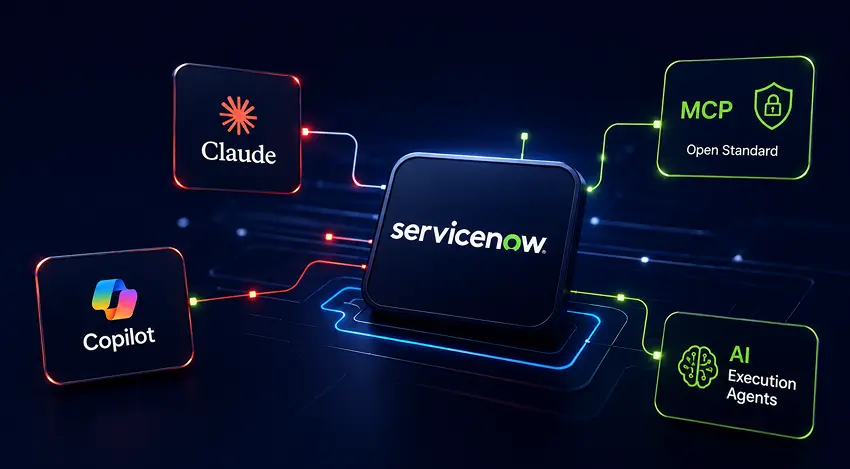
That integration friction has vanished. With MCP support ServiceNow Claude Copilot actions now operating on open standards, the enterprise AI landscape has shifted from isolated conversational assistants to fully active execution agents. By adopting the Model Context Protocol (MCP) often referred to as the "USB-C port for AI" ServiceNow enables external AI clients like Claude, Microsoft Copilot, and Cursor to discover, read, and execute ServiceNow workflows through a single governed interface. We examine what this protocol milestone means for tier-1 IT support, enterprise executives, and AWS cloud operators looking to unify their operational AI ecosystem.Demystifying MCP: The Universal Connector for Enterprise AI
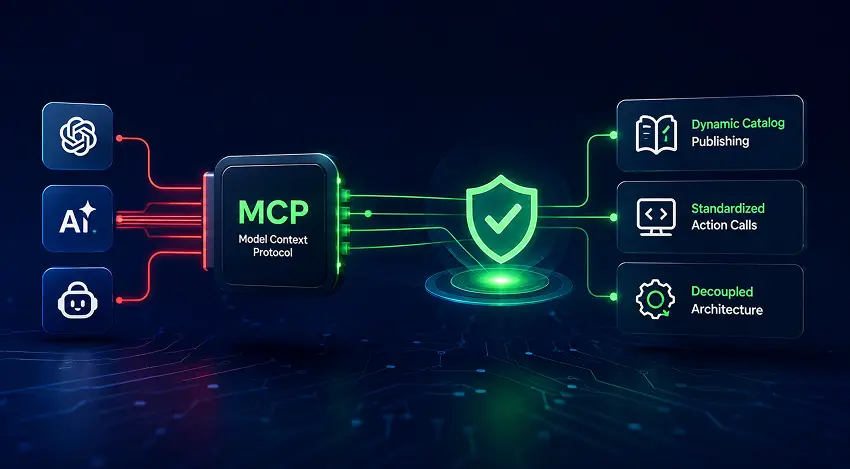
To appreciate why this protocol update is generating such momentum, we need to clarify what the Model Context Protocol actually achieves. Developed as an open standard, MCP provides a universal, standard format for large language models (LLMs) to query external data sources and trigger tools safely.
The End of Point-to-Point Connector Fatigue
In traditional architectures, exposing ServiceNow capabilities to external AI tools meant building point-to-point REST API integrations for every client platform. If an organization deployed three distinct AI assistants across technical teams, IT teams had to build and secure three separate middleware bridges.
MCP replaces that fragmentation with standardized dynamic discovery:- Dynamic Catalog Publishing (tools/list): A single ServiceNow MCP Server advertises its available capabilities such as creating tickets or inspecting change requests directly to compliant clients.
- Standardized Action Calls (tools/call): External AI engines pass structured inputs and receive clear, validated response schemas without custom payload mapping.
- Decoupled Architecture: Updating a Now Assist Skill or underlying workflow automatically updates what external AI clients can see and execute with zero client-side code changes needed.
From Chatbots to Execution: Claude and Copilot in Action
The true power of MCP lies in turning passive natural-language conversations into active platform transactions. When end users type prompts in Claude Desktop or Microsoft Copilot, those assistants no longer just explain steps they carry out the action in real time.
Real-World Use Case 1: Triage and Remediation via Claude
An engineer analyzing application telemetry inside an LLM environment like Claude can highlight an unexpected error stack and prompt: "Log a P2 incident for the checkout service and assign it to On-Call Core Infrastructure."
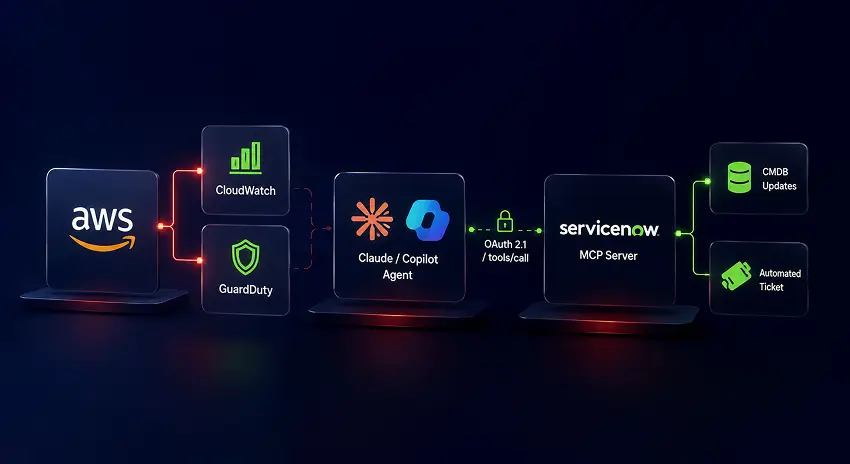
Through the MCP Server connection, Claude converts that request into a structured call, authenticates via OAuth 2.1, creates the record on the ServiceNow instance, and returns a direct deep-link to the created ticket all in seconds.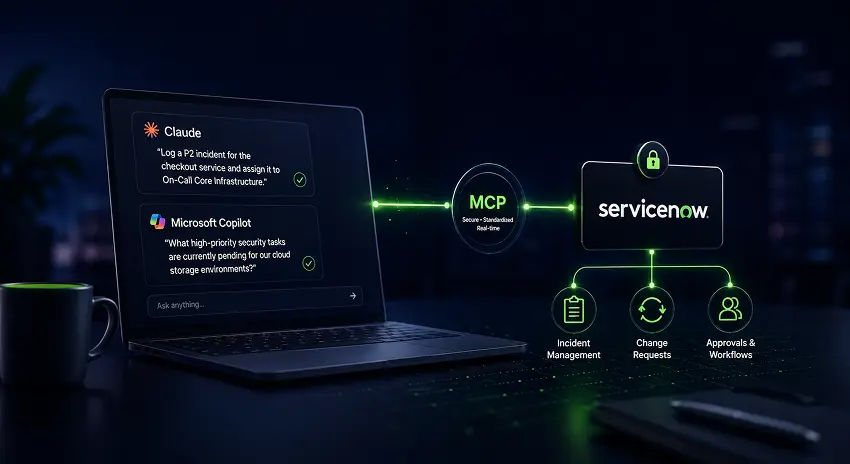
Real-World Use Case 2: Enterprise Operations via Microsoft Copilot
A manager reviewing weekly operational costs in Microsoft Copilot Studio can ask: "What high-priority security tasks are currently pending for our cloud storage environments?"
Copilot queries the ServiceNow tool catalog, pulls live record statuses, and presents actionable summary cards directly inside Microsoft Teams. If requested, Copilot can trigger a subflow to request emergency approvals straight from the chat interface.Operational Synergy for AWS Users and Cloud Architects
For teams operating complex AWS cloud footprints, MCP support bridges the gap between infrastructure orchestration and service management. When AWS Security Hub or CloudWatch flags an operational anomaly, cloud engineers frequently use AI coding assistants or standalone LLM dashboards to analyze logs. With native MCP tools published directly from ServiceNow:
- Context-Aware CMDB Correlation: The AI assistant can query the ServiceNow Configuration Management Database (CMDB) mid-investigation to verify asset ownership and business criticality.
- Automated Change Registration: Once a fix is verified, the developer's local AI agent registers an emergency change request on the ServiceNow instance without requiring the developer to context-switch across browser tabs.
- Unified Audit Trails: Every interaction initiated by external agents passes through standard ServiceNow ACLs, role checks, and AI Control Tower logs, maintaining compliance standards.
Enterprise Governance: Safety, Scope, and Control
Allowing third-party AI systems to trigger actions across core enterprise systems naturally raises security questions. We emphasize that MCP does not bypass ServiceNow's strict security and access control models.
- OAuth 2.1 Authentication: Every external client must authenticate securely, ensuring actions are tied to verified service accounts or user identities.
- Role-Based Execution (ACLs): If a user lacks permission to update a record directly in ServiceNow, their connected Claude or Copilot agent cannot perform the action on their behalf.
- Centralized Observability: Through the AI Control Tower and native system logs, administrators retain complete audit visibility over which external LLM triggered an action, the exact parameters sent, and the resulting execution output.
Key Takeaways
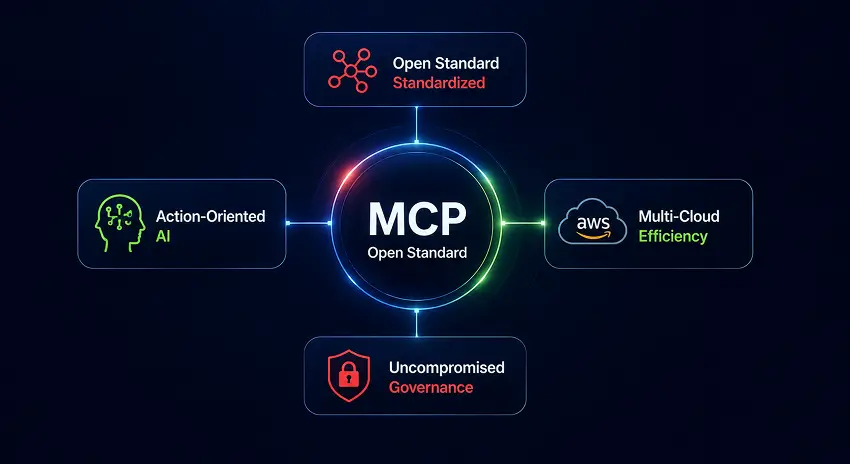
- Open Standard Standardized: MCP acts as a universal protocol for AI integrations, eliminating the need to write custom REST wrappers for every AI tool.
- Action-Oriented AI: Claude, Copilot, and other compliant clients move beyond simple answer generation to execute real-time ServiceNow tasks like incident logging, approval routing, and status checks.
- Multi-Cloud Efficiency: AWS operators and cloud architects can query CMDB records and log change events directly from their AI workspaces.
- Uncompromised Governance: Full support for OAuth 2.1, granular ACLs, and centralized audit logging ensures third-party AI automation adheres strictly to enterprise compliance guidelines.
Strategic Next Steps
Adopting MCP is more than a technical integration shortcut it is a foundation for connected, cross-platform enterprise intelligence. Whether your organization is deploying AI agents in Microsoft Copilot, configuring developer environments in Claude, or modernizing hybrid AWS workflows, our platform team is ready to assist.