Governing Behavior, Not Just Access: How CISOs Must Adapt to the Velocity of AI-Driven Risk
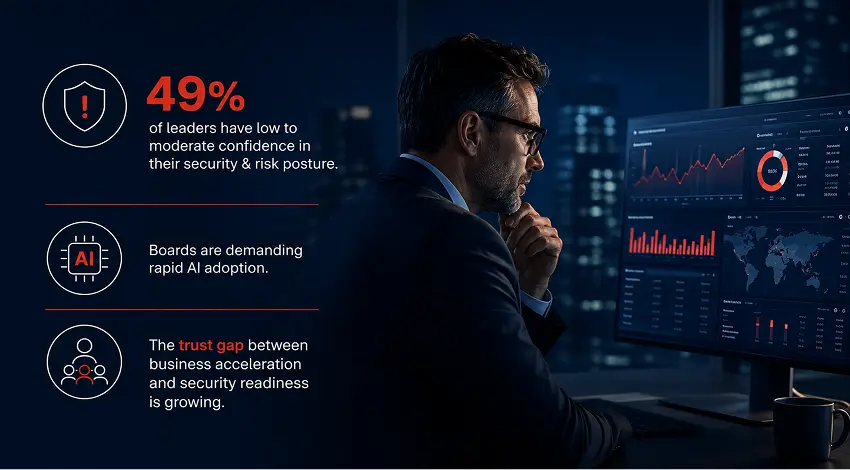
ServiceNow Workflow Ethics and Governance Thought Leadership January 22, 2026 Digital Publication A profound trust deficit is currently expanding across the leadership echelons of modern global enterprises. According to the recently published Risk and Security Outlook Report from ServiceNow, nearly half of the organizational leaders surveyed report possessing very low to moderate confidence in their overall security and risk posture. This quantitative erosion of confidence arrives precisely at a moment when corporate boards are demanding the rapid integration of artificial intelligence across core operations. The paradox is distinct: business models are accelerating into the intelligence era while the executives charged with defending those models are losing faith in their legacy protection strategies.
To analyze this structural shift in the corporate threat landscape, ServiceNow sat down for an in-depth conversation with Ben de Bont, Chief Information Security Officer (CISO) at ServiceNow. The strategic consensus is clear: artificial intelligence has fundamentally collapsed the historical distance between risk and response. In an era defined by deeply interconnected systems, programmatic identities, and autonomous enterprise workflows, an operational disruption can no longer be easily contained. Instead, vulnerabilities cascade across corporate networks at machine speed, drastically compressing the margin for error and requiring a complete reimagining of enterprise defense.The Velocity of AI Threats and the Failure of Human-Only Response Models
The underlying trend line of enterprise security threats has remained relatively consistent over recent years, but the sheer velocity of execution has undergone an exponential shift. While automated attacks and defensive scripts have existed for quite some time, artificial intelligence enables modern adversaries to seamlessly chain disparate tools together. This capabilities transformation allows attackers to dramatically expand the complexity and scale of their digital assaults, giving human security teams less time to formulate countermeasures.
Because threats now execute at AI-speed, traditional human-only response models are no longer structurally capable of keeping up with modern incident lifecycles. Autonomous security frameworks have transitioned from an experimental luxury into an absolute operational requirement. Implementing platform-led, autonomous security systems allows enterprises to detect, prioritize, and isolate active threats in real time. When grounded in transparent governance, this autonomy does not seek to replace human judgment; rather, it amplifies and extends human cognitive capacity when confronting high-velocity crises.The Nonhuman Identity Crisis: Governing Autonomous Machine Behavior
The historical enterprise security boundary, which was engineered almost exclusively around protecting human credentials and explicit user logins, has reached an irreversible breaking point. The modern enterprise network is being rapidly populated by a complex matrix of nonhuman identities, including autonomous AI agents, automated bots, decoupled service accounts, and localized system instances. These digital entities are multiplying at a rate that far outpaces traditional employee onboarding, yet each one demands the exact same rigor of supervision as a human user.
This shift fundamentally alters the foundational role of the modern CISO from managing static access rights to actively governing autonomous behavior. Because AI agents operate continuously, finalize real-time business decisions, and access sensitive backend data repositories at immense scale, they introduce an entirely new class of institutional risk. To maintain control over this expanding digital workforce, organizations must treat autonomous agents as high-privilege identities from their very first day of deployment. Centralized identity governance must become the primary control plane, allowing the business to capture rapid operational innovation without ceding control over its security perimeter.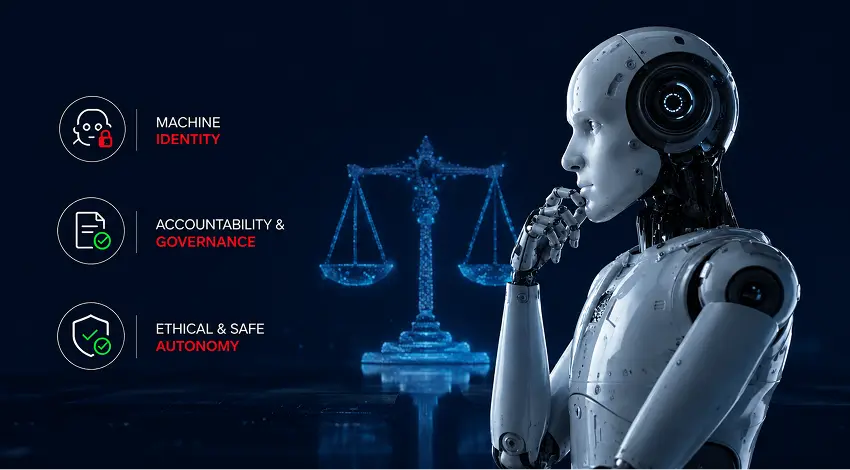
Transitioning from Static Security Controls to Workflow-Based Governance
Managing artificial intelligence risk cannot be successfully executed via a fragmented assembly of disconnected point solutions or periodic, static security checkouts. Uneven or localized AI adoption across different business units is inherently a corporate vulnerability in itself, transforming risk management from a localized technical task into a core executive leadership discipline. To ensure systemic resilience, corporate executives must align themselves around a shared, real-time view of AI vulnerability that spans the entire global footprint of the enterprise.
The solution requires a structural migration away from legacy static controls and toward integrated, workflow-based governance models. By embedding security gates, data classification protocols, and identity verifications directly into the active workflow layer, compliance parameters become visible, measurable, and highly actionable across the entire corporate ecosystem. This method shifts the organizational objective away from chasing an unrealistic standard of absolute, static perfection and focuses instead on cultivating continuous, platform-led operational resilience.What Should Organisations Do Now?
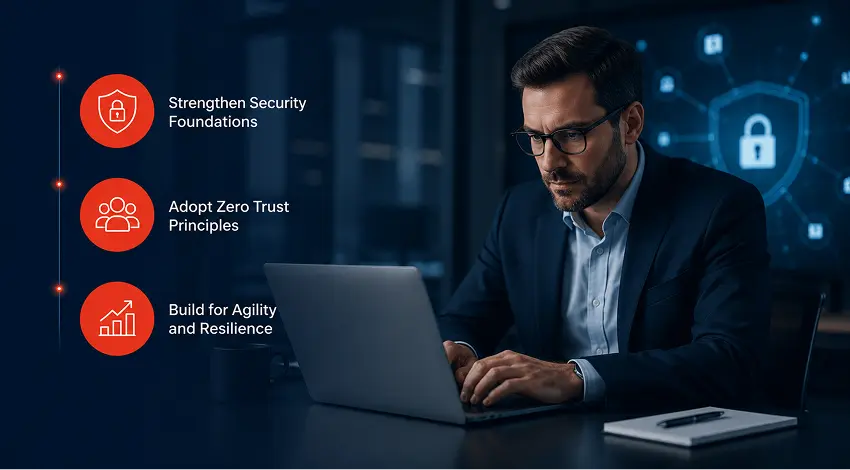
To successfully adapt internal security paradigms to the requirements of the agentic era, enterprise technology leaders and architects should implement the following strategic steps:
- Treat AI Agents as High-Privilege Identities: Audit all current AI pilots, standalone bots, and service accounts immediately, ensuring every nonhuman entity is registered under a centralized identity governance framework with clearly defined permissions and strict behavior boundaries from day one.
- Deploy Autonomous Security Orchestration: Transition away from slow, manual incident response workflows by implementing platform-led, autonomous security tools capable of detecting, prioritizing, and mitigating chained AI-driven threats in real time.
- Establish a Unified Executive Risk View: Align the C-suite and security leadership around a single, real-time reporting plane to eliminate the visibility gaps created by uneven or undocumented AI adoption across siloed departments.
- Implement Workflow-Based Governance: Integrate automated compliance gates, identity checks, and strict data-handling policies directly into core operational workflows, ensuring security checks execute natively alongside the business processes themselves.
Conclusion
While the rapid deployment of artificial intelligence undoubtedly arms adversaries with highly sophisticated mechanisms for automated disruption, those very same technologies provide defensive organizations with an unprecedented capability to move faster, analyze threat patterns with greater clarity, and respond at a truly global scale. When generative and autonomous tools are implemented thoughtfully grounded in unified platform architectures and rigid workflow-based governance security stops being a restrictive bottleneck for the business. Ultimately, the organizations that successfully master this shift will transform risk from a source of operational uncertainty into a distinct, long-term competitive advantage.