ServiceNow Launches Autonomous Workforce and Integrates Moveworks
As global enterprises struggle to navigate the expanding landscape of artificial intelligence, a fundamental divide has emerged between two competing technology paradigms. On one side stands feature-function AI, a fragmented approach where point-solution capabilities are bolted onto disconnected Software-as-a-Service (SaaS) applications. This model forces organizations to manage, maintain, and integrate the underlying operational complexity themselves. On the other side sits a unified platform approach, wherein intelligence is embedded natively into established workflows.
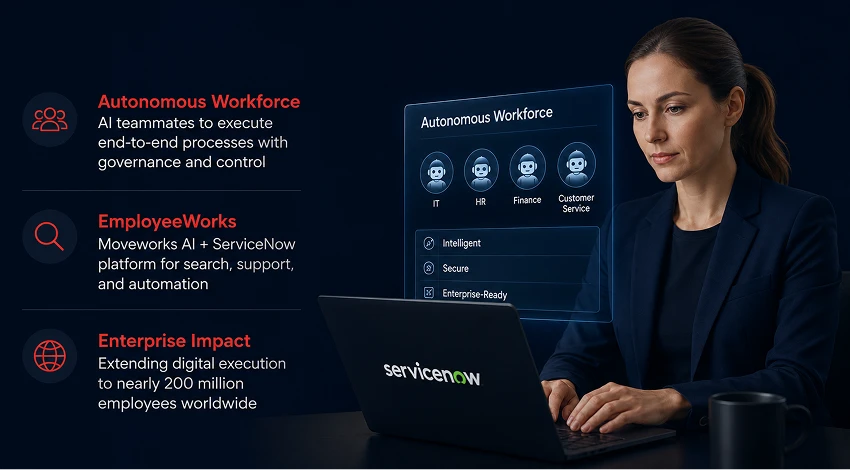
Addressing this architectural divide, ServiceNow has officially launched its Autonomous Workforce framework, introducing specialized AI teammates designed to execute end-to-end processes with the strict scope, authority, and governance required by corporate enterprises. Coinciding with this release, and arriving just two months after the finalization of its Moveworks acquisition, the company has unveiled ServiceNow EmployeeWorks. This combined solution merges Moveworks’ conversational AI and deep enterprise search capabilities with ServiceNow’s unified portal architecture and deterministic workflows, extending direct digital execution to nearly 200 million employees worldwide.The Shift From Isolated Agents to an Autonomous Workforce
Unlike isolated, task-based AI tools that merely assist human operators with discrete individual steps, the ServiceNow Autonomous Workforce coordinates entire teams of role-scoped AI specialists. These specialized digital entities are built to assume structured corporate roles such as Employee Service Agents, Security Operations Analysts, and Level 1 (L1) IT Service Desk AI Specialists and manage complex operational lifecycles from initial contact to definitive resolution. Operating alongside human employees, these digital specialists follow organizational policies, learn from transaction outcomes, incorporate direct employee feedback, and improve performance over time.
To demonstrate the real-world performance of this framework, ServiceNow revealed that its internal Autonomous Workforce is currently managing over 90% of its own employee IT requests. The deployment of the new L1 IT Service Desk AI Specialist has achieved an operational velocity that is 99% faster than the processing times typically logged by human service desk agents. This framework establishes an entirely new baseline for measurable return on investment (ROI) by scaling high-velocity execution without requiring proportional staff expansion.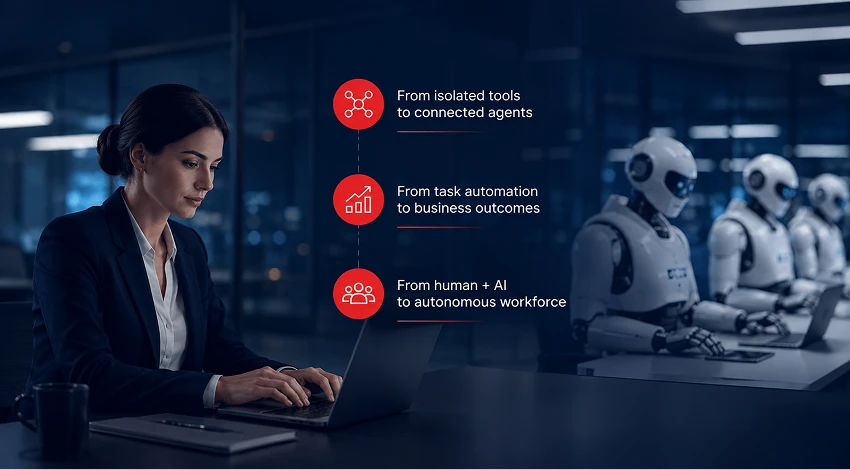
Balancing Probabilistic Intelligence with Deterministic Workflows
A central challenge of deploying standalone artificial intelligence models in mission-critical environments is their fundamentally probabilistic nature. Left unguided, standard models analyze broad data patterns, formulate hypotheses, and can provide inconsistent answers for identical queries. For corporate enterprises, such operational variance is unacceptable; businesses demand deterministic outcomes where governance, regulatory security, auditability, and absolute operational consistency are guaranteed.
The Autonomous Workforce framework directly addresses this challenge by overlaying probabilistic intelligence with ServiceNow’s deterministic workflow orchestration engine. When a digital specialist receives an input, it interprets the request using explicit business context, determines the correct path of action, and executes that action across interconnected enterprise applications. Centralized oversight is maintained continuously through the ServiceNow AI Control Tower, ensuring that every digital interaction remains auditable and constrained by governance rules embedded into the workflow layer.ServiceNow Employee Works: A Unified Conversational Front Door
The native integration of Moveworks into the ServiceNow AI Platform has culminated in the immediate general availability of ServiceNow EmployeeWorks. Operating where enterprise teams already collaborate including Microsoft Teams, Slack, and standard web browsers this unified front door combines conversational AI with deep enterprise search. The system interprets natural language intent, charts approval matrices, maps organizational authorization layers, and executes complex tasks across multiple back-end legacy environments.
By resolving actual business issues directly within the communication channel rather than merely generating summaries or opening administrative tickets, the platform bridges the historical gap between front-office interaction and back-office fulfillment. It provides consumer-grade conversational simplicity backed by enterprise reliability, enabling organizations to maintain accurate audit trails across multi-system workflows while drastically reducing the time employees spend navigating disconnected enterprise tools.Enterprise Validation: Early Adopters Report Measurable Hours Saved
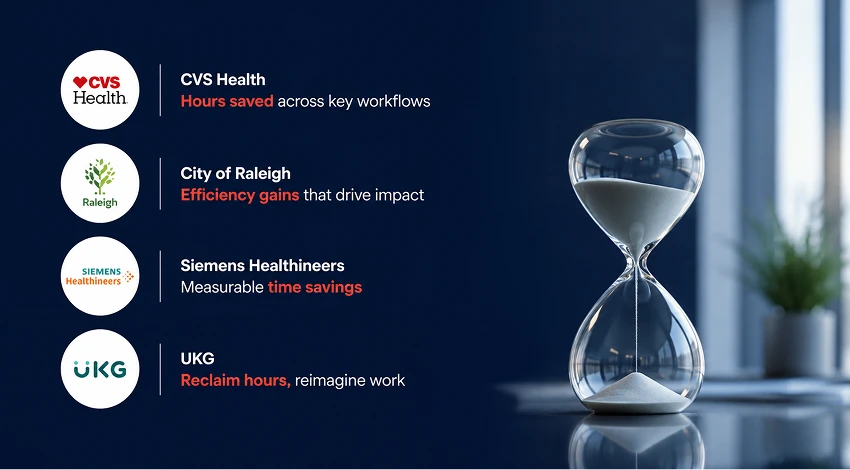
Global organizations across the public sector, healthcare, and enterprise software markets are actively utilizing these newly integrated platform capabilities to transform their daily operational models:
- CVS Health: Managing IT, HR, and procurement needs for 300,000 colleagues requires advanced platform compliance and data security. The organization focuses on leveraging platform automation for repetitive, high-volume tasks, allowing healthcare teams to dedicate their efforts to providing quality care and experiences to the 185 million people they serve.
- City of Raleigh: The municipality relies on ServiceNow Now Assist to manage routine citizen and employee interactions, intelligently routing requests to resolve 98% of initial touchpoints. This operational foundation allows municipal workers to focus on complex, high-level strategic tasks and responsible governance.
- Siemens Healthineers: Deploying the Moveworks-powered AI assistant "Ada" across a global base of 74,000 employees has automated complex workflows to save 5,000 operational hours monthly, maintaining a 91% employee satisfaction rate while freeing internal teams to focus on healthcare innovation.
- UKG: Seeking a frictionless internal experience for 15,000 employees, the organization transitioned from fragmented, reactive data systems to a predictive model utilizing the ServiceNow AI Platform. Incorporating dozens of active agentic use cases via Moveworks, the company is building toward an operational environment orchestrated entirely by specialized digital agents.
Platform Availability and Strategic Deployment Flexibility
The deployment roadmap for these new enterprise solutions balances immediate market availability with controlled rollout phases:
- ServiceNow Employee Works: This conversational front door solution is generally available to all global customers immediately.
- Level 1 Service Desk AI Specialist: The inaugural out-of-the-box specialist is in controlled availability today, with general availability scheduled for Q2 2026. This specialist handles password resets, software access provisioning, and network troubleshooting 24/7, escalating anomalies to human teams as required.
- Moveworks Standalone Product: To preserve flexibility for varied enterprise architectures, Moveworks continues to be offered as an independent product within the broader ServiceNow portfolio. Organizations can deploy it as a standalone AI platform or implement it as a fully integrated component of their existing ServiceNow ecosystem.
What Should Organisations Do Now?
To shift away from experimental AI pilots and build a fully integrated, governed digital workforce, enterprise technology leaders should adopt the following operational strategies:
- Consolidate Disconnected Point Solutions: Evaluate the existing enterprise software stack to eliminate fragmented, "bolted-on" AI tools that increase integration complexity, and transition toward unified platform architectures that combine conversational interfaces with direct workflow execution.
- Establish Governance Patterns via AI Control Tower: Prioritize the deployment of structured governance frameworks, defining explicit operational permissions, organizational scopes, and auditable authorization boundaries before deploying autonomous digital specialists into live production environments.
- Prepare for the Q2 2026 L1 IT Support Release: Audit existing IT service desk data, knowledge bases, and historical incident logs immediately to ensure the underlying documentation is structured to support the automated training and escalation paths of the Level 1 Service Desk AI Specialist upon general availability.
- Unify Communication Channels through Employe Works: Begin migrating employee service requests away from siloed portals and toward a single conversational front door within existing collaboration tools like Microsoft Teams or Slack to optimize enterprise search and request containment.
The unification of conversational AI and deterministic workflow orchestration signals a permanent shift in corporate productivity models. By deploying role-scoped AI specialists that think within organizational guardrails and act across core enterprise systems, modern businesses can systematically eliminate operational friction, lower administration costs, and empower human personnel to dedicate their efforts to strategic problem-solving.