Why the Most Important Role in Your 2026 IT Team Isn’t a Dev, but an AI Agent Supervisor
For the last decade, the IT talent war was simple: hire more developers. If your organisation wanted to innovate faster, minimise downtime, or scale its infrastructure, you needed engineers to write code, build integrations, and configure workflows.
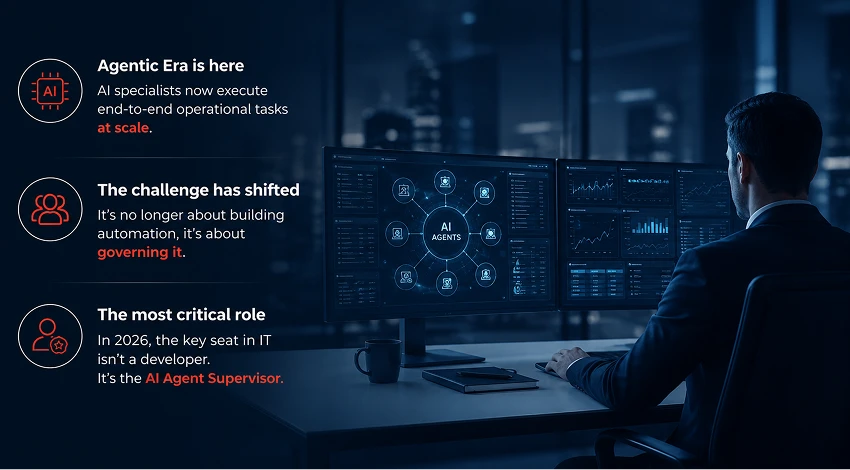
But as we hit the midway point of 2026, the tech landscape has experienced a dramatic structural shift. We have officially entered the Agentic Era.With ServiceNow launching its Autonomous Workforce initiative at Knowledge 2026, AI specialists spanning IT Service Management (ITSM), AIOps, Site Reliability Engineering (SRE), and SecOps are now executing end-to-end operational tasks at a scale humans can't match.The primary challenge is no longer building automation. It’s governing it. Because of this, the most critical seat in your 2026 IT organization isn’t a developer writing code. It’s the Controller the AI Agent Supervisor.With Ripton Solutions, understand what and how the AI Agent Supervisor works and how it can make an impact.What is a "Controller" (AI Agent Supervisor)?
An AI Agent Supervisor, or "Controller," is a new breed of IT professional. They don’t write code, but they understand enterprise workflow orchestration intimately. Their job is to define business intent, establish operational parameters, continuously monitor AI behaviour, and act as the definitive "human-in-the-loop" for complex exceptions.
Think of it like an air traffic control room. The AI agents are the planes executing autonomous flights; the Controller is the supervisor ensuring they stay on course, follow safety regulations, and don't collide.
The Shift in Numbers: From Creation to Governance
- The Old Way (Pre-2026): 80% of IT bandwidth spent on writing scripts, mapping flows, and fixing broken integrations.
- The Agentic Way (2026): 80% of IT execution handled by autonomous agents. Human bandwidth shifts entirely to strategy, guardrail optimisation, and performance auditing.
Why 2026 Changed Everything: The ServiceNow Technical Reality
If you are running on ServiceNow today, the technology supporting this shift isn't a futuristic roadmap it’s live production reality. The latest 2026 updates have introduced powerful architectural modules that make the Controller role an absolute operational necessity:
ServiceNow AI Control Tower
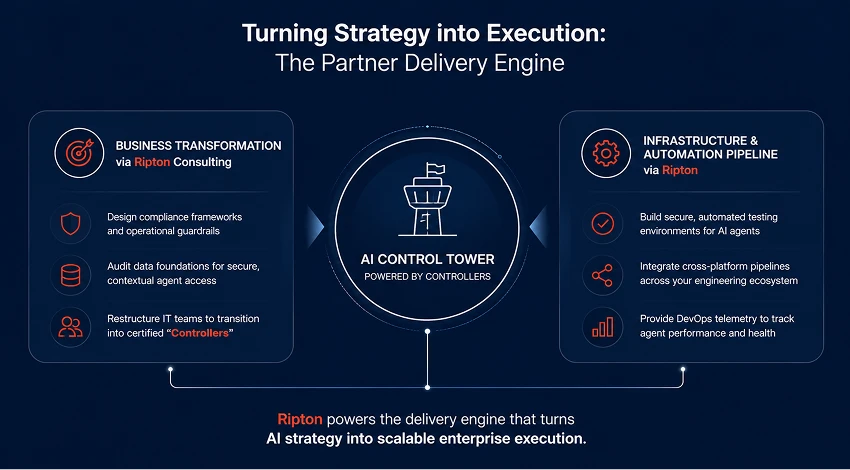
At the heart of this shift is the ServiceNow AI Control Tower. This serves as the Controller's primary command centre. Instead of managing fragmented AI scripts, Controllers use this single pane of glass to:
- Register and Govern: Track every native Now Assist agent, Model Context Protocol (MCP) server, and external third-party agent running across the ecosystem.
- Enforce Guardrails: Set natural language rules that dictate exactly what data an agent can touch, ensuring strict compliance and preventing prompt injections around the clock.
AI Agent Studio & Agentic Workflows
The platform has evolved past rigid flow charts. Controllers use the AI Agent Studio to build and configure multi-agent collaborations. Using Agent2Agent protocols, an AIOps Specialist agent can autonomously detect a network anomaly, spin up an SRE specialist agent to triage the problem, and automatically log a postmortem all while the Controller monitors the execution log traces in real time.
AI Agent Advisor & Value Insights
How do you know if your digital workforce is actually performing? Controllers rely on the AI Agent Advisor embedded within the Now Assist Center. It discovers latent automation opportunities, tracks agent adoption rates, and utilizes Now Assist Value Insights to map AI performance directly to realized ROI and business outcomes.
Turning Strategy into Execution: The Partner Delivery Engine
Deploying a state-of-the-art AI Control Tower isn't a plug-and-play project; it requires deep platform architecture expertise, organizational restructuring, and a tightly integrated technical toolchain. To actually scale this new "Controller" framework, enterprises rely on a powerful partner delivery engine:
Business Transformation via Ripton Solutions Consulting
Before an AI Agent Supervisor can manage a digital workforce, those autonomous agents must be mapped to real, value-driven business workflows. As an elite digital transformation specialist, Ripton Solutions Consulting bridges the gap between raw AI capability and enterprise execution.
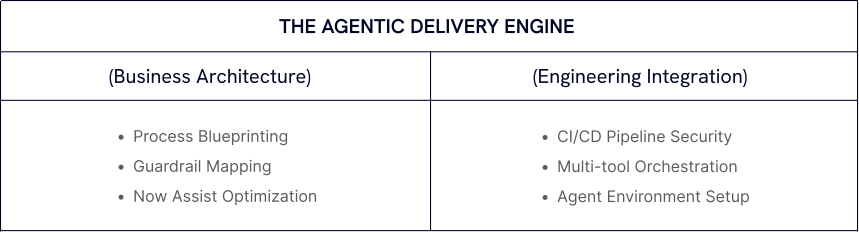
Ripton Solutions methodology focuses on shifting your traditional IT team into high-value governance roles by:- Designing the compliance frameworks and operational guardrails required by the AI Control Tower.
- Auditing data foundations to ensure Now Assist agents have contextual, secure access to corporate knowledge.
- Restructuring IT organizations to transition legacy administrators into certified "Controllers smoothly.
Infrastructure & Automation Pipeline via Ripton Solutions
An AI agent is only as effective as the technical environment it operates in. Ripton Solutions ensures that your underlying development pipelines, multi-tool environments (including Jira, GitHub, and cloud infrastructure), and automated workflows are fully optimized to support agentic execution.
Ripton Solutions provides the technical scaffolding that allows Controllers to succeed by:
- Building secure, automated testing environments where new AI agents can be safely simulated before hitting production.
- Integrating cross-platform pipelines so ServiceNow agents can seamlessly trigger and monitor actions across your entire engineering ecosystem.
- Providing the DevOps telemetry needed for Controllers to track agent performance, speed, and deployment health.
The Day-to-Day Responsibilities of an AI Agent Supervisor
With the right platform architecture and partner scaffolding in place, what does a Controller actually do during a standard shift?
- Intent and Speciality Definition: They program agents using natural language instructions, specifying their "speciality," giving them access to tools (like Knowledge Graphs, subflows, or REST APIs), and defining their security boundaries.
- Exception Remediation: When an agent encounters an edge case that breaches its confidence threshold, it halts and hands the case to the Controller with an autonomous summary.
- Continuous Optimization: Utilizing built-in Process Mining, Controllers analyze how AI agents are executing workflows right where they run, uncovering bottlenecks and refining prompt instructions to optimize future performance.
How to Prepare Your Team for the Shift
The transition to an Agentic Business model doesn’t mean your current IT team is obsolete it means they need to elevate. Your best system administrators and business analysts are perfectly positioned to step into Controller roles.
- Stop Upskilling Solely for Code: Pivot training paths toward decision intelligence, enterprise risk management, and prompt engineering architecture.
- Audit Your Data Infrastructure: AI agents are only as good as the context they consume. Cooperate with partners to optimise Knowledge Bases and standardise Service Catalogues to effectively fuel your digital workforce.
- Establish Governance Frameworks Now: Don't wait for "AI chaos." Deploy the AI Control Tower early to align your agentic initiatives with overarching enterprise strategy before scaling out your autonomous workforce.
The Bottom Line
The business value of AI in 2026 isn't found in isolated pilots or simple chat widgets. It's found in sustained, enterprise-wide execution.
As ServiceNow scales autonomous workflows into production, companies that focus solely on hiring builders will fall behind. The future belongs to organizations that master control.