Beyond the Chatbot: 5 ServiceNow Workflows That Agentic AI Will Handle End-to-End (Without Human Clicks)
For the past couple of years, enterprise leaders have been under a massive illusion regarding the true power of artificial intelligence. We rolled out Generative AI chatbots, celebrated when they summarized long comment threads, and called it a revolution.
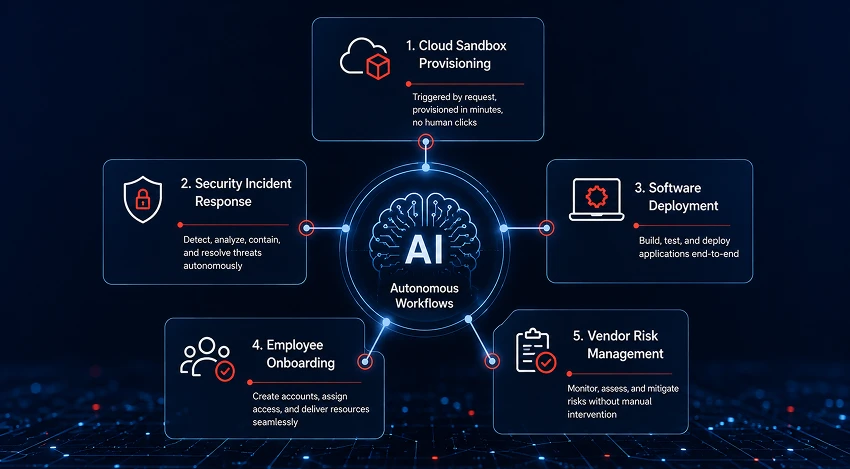
But a chatbot that simply spits out text instructions still leaves the actual work to a human. If a user asks, "How do I provision a cloud sandbox?" and the AI responds with a five-step checklist, your employee still has to spend 20 minutes clicking through portals to get it done. That isn't digital transformation; it is just a glorified search engine. We have officially graduated from the era of conversational assistants and entered the era of the Autonomous Workforce. Powered by the latest 2026 platform capabilities natively driven by ServiceNow Otto™ and AI Agent Studio, the target has shifted. We are no longer building tools that suggest answers; we are deploying specialized AI Agents that possess the reasoning, permissions, and cross-tool integration to execute entire operational workflows from initial trigger to absolute final closure completely bypassing the need for human clicks. Here are five enterprise workflows that ServiceNow Agentic AI is taking over end-to-end.Proactive Infrastructure Self-Healing
The traditional IT Operations Management (ITOM) cycle is notoriously reactive. A server volume hits 99% capacity at 2 AM, an monitoring tool fires an alert, a ticket is cut, and an on-call engineer is woken up to manually purge logs and restart the service.
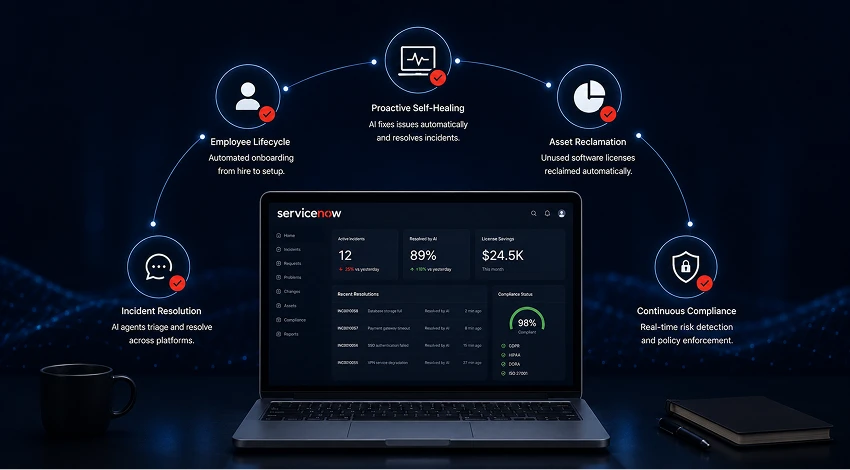
In 2026, the AI Agent Orchestrator completely removes human latency from this cycle. When ServiceNow Event Management detects a critical storage error on a production database, a specialized ITOM Agent steps in. It evaluates the environment against CSDM 5.0 rules, recognizes it as a pre-approved standard change, and utilizes Integration Hub spokes to connect to the target machine. The agent independently clears the corrupted temporary folders, verifies the application's health metrics, updates the incident's internal work notes with an execution log trace, and resolves the ticket. The human team only finds out when they look at their morning success dashboard.
Dynamic Software Asset Reclamation
Software asset managers spend countless hours running manual usage audits, chasing down employees who haven't opened an expensive specialized application in months, and manually clawing back licenses to stay within budget.
Agentic AI turns IT Asset Management (ITAM) into a self-optimizing system. Operating continuously in the background, a Software Asset Management Agent analyzes utilization telemetry across your cloud tenants. When it identifies an employee who hasn't leveraged a high-cost license for 90 days, it doesn't just send a passive alert. The agent checks the company's active optimization policy, automatically revokes the software entitlement via Azure AD or Okta, harvests the license back into the corporate pool for immediate reallocation, logs the exact dollar amount saved inside the ITAM dashboard, and fires a polite, automated status notification to the employee.
End-to-End Employee Lifecycle Provisioning
When a new hire joins an organization, the onboarding process touches IT, HR, and Facilities. Traditionally, an HR representative fills out a form, which then fires separate sub-tasks to various teams: one to create an email account, one to grant security permissions, and another to order a laptop.
With Agentic Playbooks, the entire sequence is handed to an autonomous HR Agent. The moment an employment contract is finalized in your Applicant Tracking System, the agent interprets the specific role constraints using natural language reasoning. It triggers cross-platform subflows to instantly stand up the employee profile, configures role-based access tokens across various third-party SaaS apps via the Model Context Protocol (MCP), assigns the target baseline hardware from live inventory, and updates the case to complete. The workflow moves from stage to stage autonomously because the AI satisfies the data requirements of each step independently.
Cross-Platform Incident Triage and Resolution
Customer service agents are routinely bogged down by complex multi-system issues. For example, a customer reports that their loyalty points disappeared after a transaction failed. A human worker would normally have to open ServiceNow Customer Service Management (CSM), log into a legacy billing database, check an external payment gateway, and manually calculate the discrepancy.
Using Agent2Agent (A2A) protocols embedded within ServiceNow’s AI Agent Fabric, specialized digital workers collaborate to fix this without a single human touch. A CSM Agent ingests the incoming natural language complaint, coordinates with an external financial platform agent via secure API wrappers to locate the interrupted transaction, adjusts the ledger balances, re-credits the customer's account, and responds to the user with an exact breakdown of the resolution.
Continuous Real-Time Compliance Enforcements
Maintaining alignment with rigid frameworks like GDPR, HIPAA, or DORA usually involves manual sample testing and panicked retrospectives before an audit.
Security Operations (SecOps) and Governance Risk and Compliance (GRC) agents now enforce these guardrails continuously. An autonomous compliance agent perpetually monitors active platform transactions and database configuration changes. If a developer accidentally updates a workflow in a way that exposes sensitive patient data to an unauthorized user tier, the agent catches the anomaly mid-execution. It instantly blocks the specific data pathway, generates an audit-ready compliance report detailing the policy violation, logs an active Security Incident, and locks down the configuration until an authorized human supervisor approves a remediation plan.The Strategic Reality: Moving to the Control Tower
This level of absolute automation completely redefines the role of human IT professionals. We are moving away from an era where humans act as the computational engines executing the steps, and moving into an era where humans act as strategic supervisors.
By utilizing the ServiceNow AI Control Tower, your existing IT leaders aren't writing code or manually fulfilling tasks anymore. Instead, they use natural language to set the boundaries, define the operational guardrails, and audit the performance of a digital workforce that executes millions of complex enterprise workflows flawlessly.The businesses winning the operational race are no longer measuring success by how fast their teams can click through forms. They are measuring success by how many clicks they have eliminated entirely.