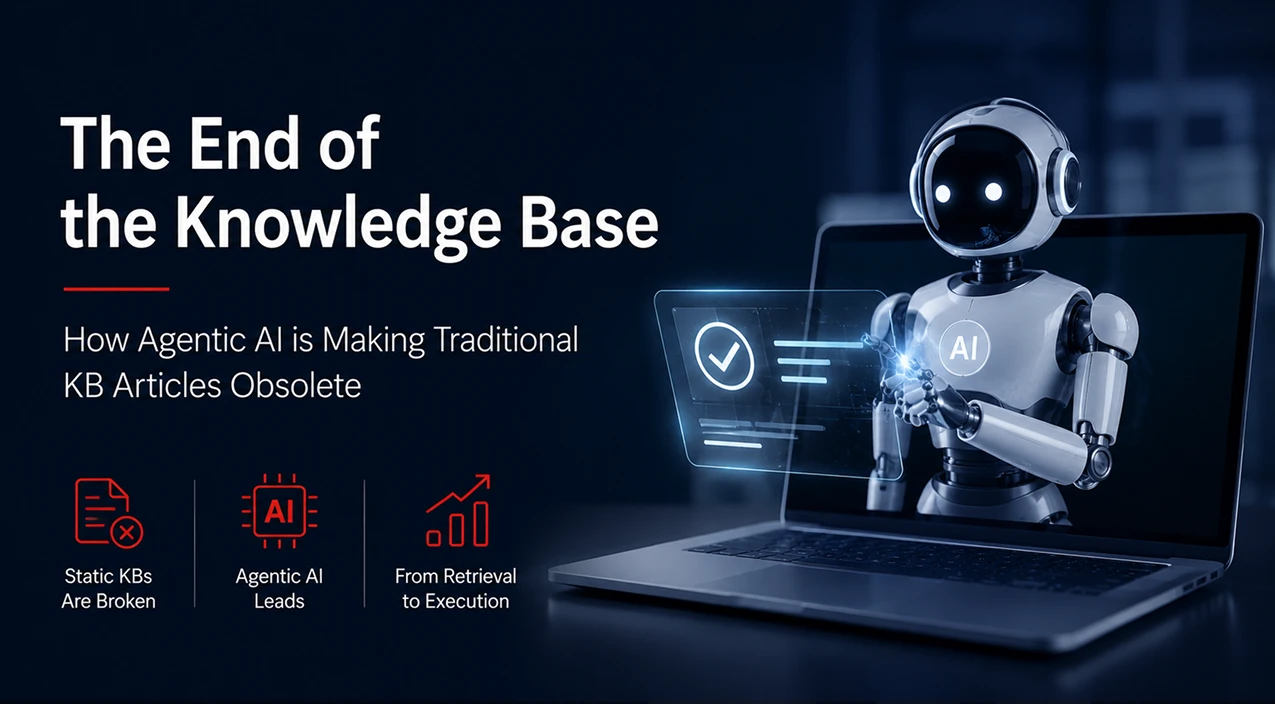
The End of the Knowledge Base: How Agentic AI is Making Traditional KB Articles Obsolete
For decades, the standard blueprint for enterprise IT support and user assistance has centered on the document repository. The strategy was predictable: recruit specialists to document system fixes, publish them as static articles, and hope employees would look them up to solve their own technical problems.
Let’s be honest: this methodology has always been fundamentally broken. It generates immense administrative overhead, becomes inaccurate the moment software updates, and forces human technicians to act as manual index filters combing through dense text blocks just to find a single configuration variable.As we move through 2026, that blueprint has completely broken down. Driven by the architectural advancements introduced in ServiceNow’s latest platform cycles, the industry is experiencing a massive evolution: the retirement of static information repositories. With the widespread adoption of Agentic AI, enterprise operations are shifting from passive document retrieval to active execution led by autonomous digital specialists.The Legacy Bottleneck: Why Documentation Fails Modern IT
According to recent industry benchmarks, enterprise investments in automated systems have surged dramatically over the past year. Organizations are aggressively financing these initiatives because they recognize that manual documentation can no longer keep pace with modern operational speed.
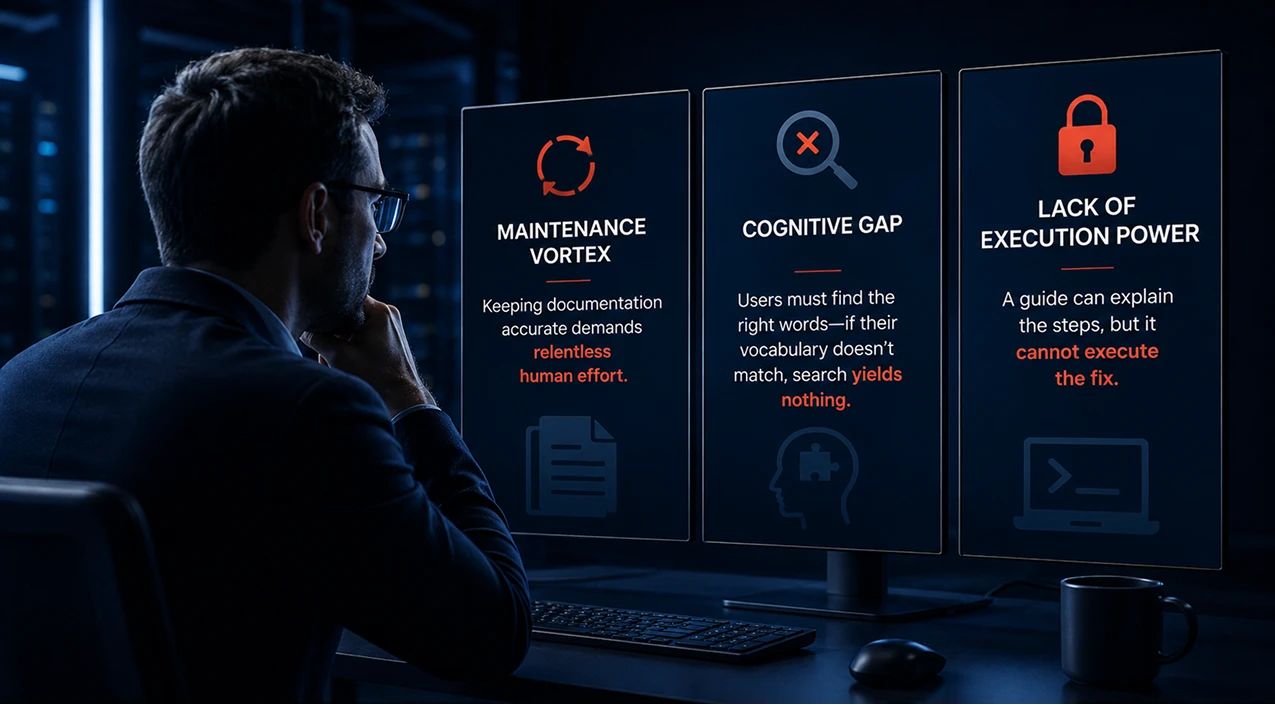
Relying on standard documentation infrastructure introduces three severe operational challenges:
- The Maintenance Vortex: Keeping a repository accurate demands relentless human effort. Guides must be constantly authored, validated, categorized, and phased out to prevent conflicting instructions."
- The Cognitive Gap: Users must translate a real-world technical symptom into precise index keywords. If their vocabulary doesn't match the written text, the search yields nothing.
- Lack of Execution Power: A text guide can explain the steps required to repair a corrupted profile, but it cannot actively log into an identity provider, clear system caches, or issue a new security token. It informs the reader, but it cannot resolve the issue.
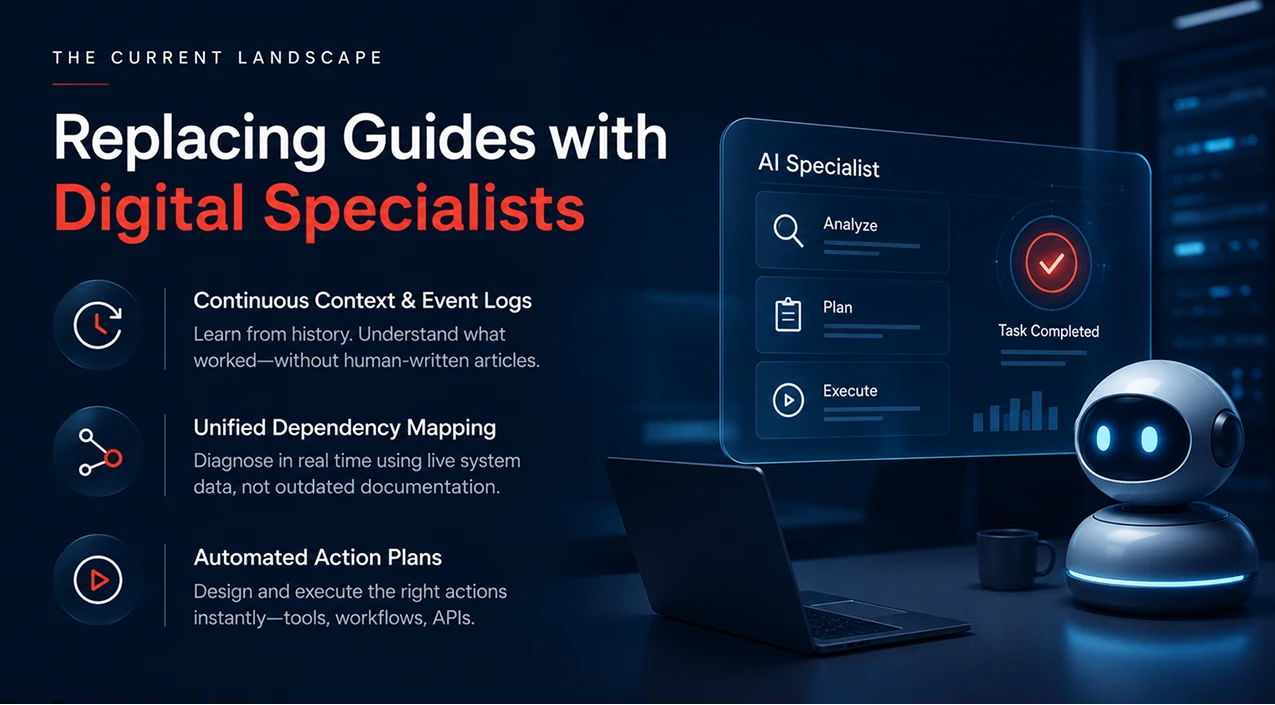
The Current Landscape: Replacing Guides with Digital Specialists
Enterprise technology has progressed far beyond the limited generative chat frameworks of the past. Modern IT operations rely on Autonomous AI Specialists intelligent units embedded within existing teams, assigned specific operational goals, and authorized to run automated processes from start to finish.
Because of this evolution, the concept of "organizational knowledge" has been redefined. Instead of parsing flat data files or reading layout templates, modern digital workers analyze live system metadata and platform history to act in real time. The latest platform capabilities replace traditional documentation through three distinct pillars: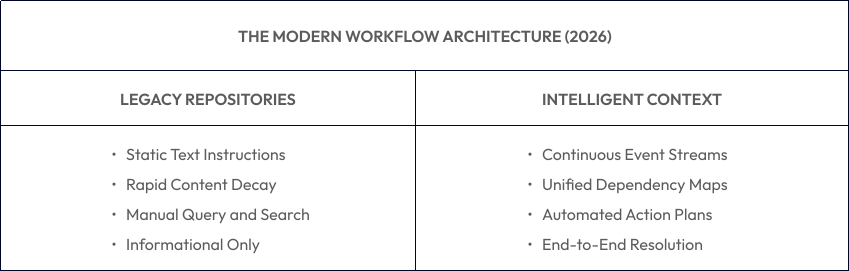
Continuous Context Recovery & Event Logs
Modern digital specialists do not depend on isolated text files. Instead, they leverage continuous context recovery systems and integrated event logs. The system perpetually gathers insights from historical machine data, past ticket lifecycles, and backend infrastructure paths understanding what resolved a problem previously without needing a human to draft an explanatory article"
Unified Dependency Mapping
Instead of referencing disconnected documentation, systems utilize a live dependency map tracking corporate configuration items, service architectures, and real-time environment metrics. When an operational fault occurs, the digital worker reviews the live environment state to diagnose the issue instantly, referencing actual system behavior rather than a guide written months prior.
Automated Action Plans
When a request is submitted, the platform does not simply provide a link to an instruction sheet. Utilizing dedicated orchestration interfaces, the digital specialist designs an immediate resolution plan. It selects and activates the precise tools required whether running background workflows, executing API requests, or running infrastructure commands safely operating within designated natural language boundaries.
Shifting Focus: Transforming Existing Assets into Operational Fuel
This shift does not mean you should delete your historical support repositories. However, your organization's approach to this data must undergo a structural transformation.
Instead of structuring documentation for human reading, your historical archives must be adapted to serve as clean foundational training data for automated workers. Optimization tools are used to purge outdated information and resolve conflicting instructions, ensuring that automated systems can ground their decisions in accurate data.Human teams are likewise pivoting from content generation to strategic governance. Instead of mapping out step-by-step instructions for end users, IT experts utilize advanced governance hubs to define operational boundaries, protect sensitive variables, and establish approval check-points for autonomous systems.The Future Blueprint
The next phase of enterprise service delivery is a self-remediating environment where the boundary between identifying a problem and implementing its fix is completely eradicated.The enterprises leading the market are not those maintaining the largest libraries of written procedures. Success belongs to companies that liberate their data from isolated silos and embed active intelligence directly into daily workflows.The era of the manual knowledge base is drawing to a close. It is time to stop writing about technical issues, and let intelligent automation fix them.